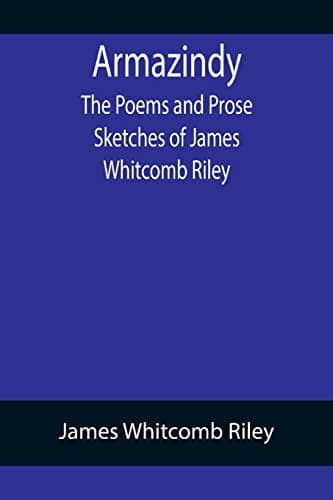
Armazindy: The Poems and Prose Sketches of James Whitcomb RileyRiley, James Whitcomb
General
Armazindy: The Poems and Prose Sketches of James Whitcomb Riley
Riley, James Whitcomb
American poetry -- 19th century
Mr. Twiggs put down his tea without tasting it. “Tudens,” he said, after
a long pause, in which he carefully buttered a piece of toast for the
second time,—“Tudens, I’m ’most afeard you didn’t grasp that last remark
of mine: I was a-sayin’—”
“Well—” said Tudens, attentively.
“I was a-sayin’,” said Mr. Twiggs, averting his face and staring
stoically at his toast—“I was a-sayin’ that you was a-gittin’ now to be
quite a young woman.”
“Oh, so you were,” said Tudens, with charming naïveté.
“Well,” said Mr. Twiggs, repentantly, but with a humorous twinkle, “if I
wasn’t a-sayin’ of it, I was _a-thinkin’_ it.”—And then, running along
hurriedly, “And I’ve been a-thinkin’ it for days and days—ever sence
you left the ‘balley’ and went in ‘chambermaids,’ and last in leadin’
rôles. Maybe _you_ ain’t noticed it, but I’ve had my eyes on you from the
‘flies’ and the ‘wings’; and jest betwixt us, Tudens, and not for me as
ort to know better, and does know better, to go a-flatterin’, at my time
o’—or to go a-flatterin’ anybody, as I said, after you’re a-gittin’ to
be a young woman—and what’s more, a werry _’andsome_ young woman!”
“_Why, Pop’m!_” exclaimed Tudens, blushing.
“Yes, you are, Tudens, and I mean it, every word of it; and as I was
a-goin’ on to say, I’ve been a-watchin’ of you, and a-layin’ off a long
time jest to tell you summat that will make your eyes open wider ’an
that! What I mean,” said Mr. Twiggs, coughing vehemently and pushing his
chair back from the table—“what I mean is, you’ll soon be old enough to
be a-settin’ up for yourself-like, and a-marry’—W’y, Tudens, what _ails_
you?” The girl had risen to her feet, and, with a face dead white and
lips all tremulous, stood clinging to her chair for support. “What ails
you, Tudens?” repeated Mr. Twiggs, rising to his feet and gazing on her
with a curious expression of alarm and tenderness.
“Nothing serious, dear Pop’m,” said Tudens, with a flighty little
laugh,—“only it just flashed on me all at once that I’d clean forgotten
poor ‘Dick’s’ supper.” And as she turned abruptly to the parrot, cooing
and clucking to him playfully,—up, up from some hitherto undreamed-of
depth within the yearning heart of Mr. Twiggs mutely welled the old
utterance, “Tude’s a queer girl!”
“Whatever made you think of such a thing, Father?” called Tudens,
gayly; and then, without waiting for an answer, went on cooing to the
parrot,—“Hey, old dicky-bird! do _you_ think Tudens is a handsome young
woman? and do _you_ think Tudens is old enough to marry, eh?” This query
delivered, she broke into a fit of merriment which so wrought upon the
susceptibilities of the bird that he was heard repeatedly to declare and
affirm, in most positive and unequivocal terms, that Tude had actually
come home.
“Yes—_sir_, Tudens!” broke in Mr. Twiggs at last, lighting a fresh
churchwarden and settling into his old position at the grate; “have your
laugh out over it now, but it’s a werry serious fact, for all that.”
Public-domain text, read in full here on John Shaqi.
Reviews
Reviews
No reviews yet
Be the first to share your thoughts on this work.
Join the Discussion
Join the discussion
Sign in to leave a comment or review.
Sign InorCreate an account