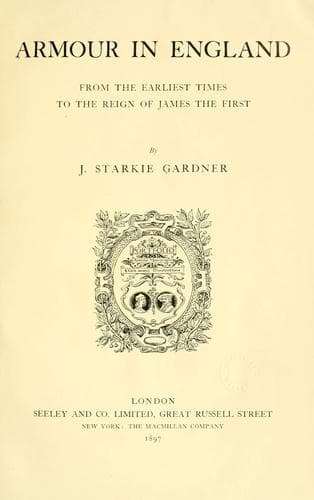
Armour in England, from the Earliest Times to the Reign of James the FirstGardner, John Starkie
History
Armour in England, from the Earliest Times to the Reign of James the First
Gardner, John Starkie
Armor -- England
The weight and fashion of the armour largely determined the tactics in
war. The English appear at this time to have reverted to their ancient
practice, once more dismounting to engage in battle. At Cressy the
horses were sent to the rear, while the army, forming into battalions
of archers supported by dismounted men-at-arms, took up its ground and
waited the attack. The weight of armour carried by the men-at-arms made
any forward movement on their part impossible on foot. By good fortune
the 15,000 Genoese cross-bowmen, who might have inflicted severe loss
on the English, were unable to use their bows, and the French coming
up quite out of hand, charged and retreated as the spirit moved them,
without deploying into any battle formation, and so fell into the
utmost confusion, with the well-known results. Our archers "shot their
arrows with such force and quickness that it seemed as if it snowed,"
piercing the Genoese and dismounting the horsemen; upon which a body of
1000 Welsh foot with long knives advanced through the men-at-arms, who
made way for them, and slew numbers of the French chivalry, so that the
battle was "murderous and cruel."
At Poitiers, 1356, the English similarly selected a strong position and
awaited the attack dismounted. The French, uncertain how to meet the
enemy, commenced by attacking with a mounted division, which was routed
by the effect of the English arrows on the horses before getting to
close quarters. Their retreat threw the second battalion, which also
appears to have been mounted, into a confusion, which quickly developed
into a panic. Deeming an advance necessary at this critical moment,
the English men-at-arms sent to the rear for their horses and charged,
completing the destruction and dispersal of all but the rear battalion.
This was dismounted in order to fight on foot, and armed with sword and
battle-axe presented a most stubborn front, under the king in person,
numerous parties from the broken battalions rallying and dismounting
to join in its advance. The English resumed the defensive and remained
immovable, the archers plying their arrows with the usual effect. The
only English force capable of movement and able to skirmish in the
field was the archery, while the men-at-arms kept their ground or
advanced very slowly in compact order, until, seeing the day won, they
again mounted to complete the discomfiture and engage in pursuit.
Public-domain text, read in full here on John Shaqi.
Reviews
Reviews
No reviews yet
Be the first to share your thoughts on this work.
Join the Discussion
Join the discussion
Sign in to leave a comment or review.
Sign InorCreate an account