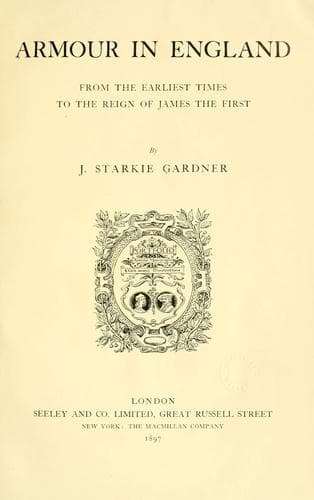
Armour in England, from the Earliest Times to the Reign of James the FirstGardner, John Starkie
History
Armour in England, from the Earliest Times to the Reign of James the First
Gardner, John Starkie
Armor -- England
The costume of the unfortunate Wyatt on his rebellion is described in
the chronicles of Jane and Queen Mary as "a shert of mayll with sleves,
very fayre and thereon a velvet cassoke and an yellowe lace with the
windelesse of his dag hanging thereon, and a paire of botes and spurres
on his legges; on his hedd he had a faire hat of velvet with broade
bonne-work lace about it." Soon after a "shippe laden with shertes of
mayll" was brought in by Strangwyshe the Rover, "who came from the
French king and submitted to the Queen's mercy." The celebrated duel
between Jarnac and La Chateigneraye was fought in shirts of mail.
In the Scottish wars of Edward I. it was a common saying that "arrows
can penetrate the hardest mail"; and more efficient armour had to be
devised. Simon de Montfort, standing like a tower and wielding his
sword with both hands, was pierced in the back by a foot soldier who
lifted up his mail. The hero died with "Dieu merci" on his lips; not
the only victim who met his death in this manner. The change in the
fashion of armour was hastened by such events. The process has already
been traced: it began at the knee-caps, which were covered by plates
called poleyns. Three actual and perfectly unique specimens of these,
belonging to Sir Noël Paton, show that they were not laid upon or over
the mail, but replaced it, as represented in monumental effigies. One
pair with parallel sides is finely embossed and vandyked, closely
resembling those of some early fourteenth century effigies. A globose
example formed of three articulated plates is still more interesting,
having been richly damascened with an arabesque design worked in thin
brass lines, the field being delicately and closely cross-hatched with
incised lines. The really remarkable and unexpected surface decoration
this discloses explains the nature, and confirms the accuracy, of
certain fourteenth century representations of black armour covered with
fine gold arabesques. The cross-hatching served to retain the black
pigment, and gave a dark cast to the steel surface, enhancing the value
of the delicate brass inlay.
The process of reinforcing the mail defence was continued, as we have
seen, until it was entirely cased with an outer shell of plate. A
quilted coat was worn beneath the mail, if not a second one between the
mail and plate armour. These multiplied defences must have made active
fighting difficult and most fatiguing, and were discarded so soon
as a light armour of fine steely quality, and without crevices, was
procurable.
III
GOTHIC ARMOUR
Public-domain text, read in full here on John Shaqi.
Reviews
Reviews
No reviews yet
Be the first to share your thoughts on this work.
Elsewhere in the archive
Join the Discussion
Join the discussion
Sign in to leave a comment or review.
Sign InorCreate an account