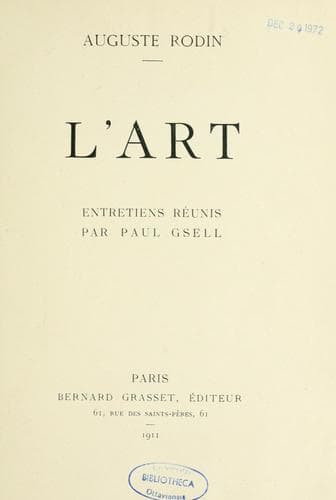
Art; Artists; Artists -- France -- Interviews; Sculpture
“Let Velasquez paint Sebastian, the dwarf of Philippe IV. He endows him
with such a touching gaze that we instantly read in it all the painful
secret of this poor afflicted creature, forced, for his livelihood, to
lower his human dignity, to become a plaything, a living bauble. And the
more poignant the martyrdom of the conscience lodged in this grotesque
body, the more beautiful is the artist’s work.
“Let François Millet represent a peasant resting for a moment as he
leans on the handle of his hoe, a wretched man worn by fatigue, baked by
the sun, as stupid as a beast of burden dulled by blows—he has only to
put into the expression of this poor devil a sublime resignation to the
suffering ordained by Destiny, to make this creature of a nightmare
become for us the great symbol of all Humanity.
“Let Beaudelaire describe a festering corpse, unclean, viscid, eaten by
worms, and let him but imagine his beloved mistress under this frightful
aspect, and nothing can equal in splendor his picture of this terrible
juxtaposition of beauty which we could wish eternal and the atrocious
disintegration which awaits it.
“Et pourtant vous serez semblable à cette ordure,
A cette horrible infection.
Etoile de mes yeux, Soleil de ma nature,
O mon ange et ma passion!
Oui, telle vous serez, o la reine des Grâces
Après les derniers sacrements.
Quand vous irez sous l’herbe et les floraisons grasses
Pourrir parmi les ossements.
Alors, o ma Beauté, dîtes à la vermine
Qui vous mangerez de baisers,
Que j’ai gardé la forme et l’essence divine
De mes amours décomposés![3]
Footnote 3:
See page 250.
[Illustration:
THE MAN WITH THE HOE
By Millet
]
“It is the same when Shakespeare depicts Iago or Richard III., when
Racine paints Nero and Narcissus; moral ugliness when interpreted by
minds so clear and penetrating becomes a marvellous theme of beauty.
“In fact, in art, only that which has _character_ is beautiful.
“_Character_ is the essential truth of any natural object, whether ugly
or beautiful; it is even what one might call a _double truth_, for it is
the inner truth translated by the outer truth; it is the soul, the
feelings, the ideas, expressed by the features of a face, by the
gestures and actions of a human being, by the tones of a sky, by the
lines of a horizon.
“Now, to the great artist, everything in nature has character; for the
unswerving directness of his observation searches out the hidden meaning
of all things. And that which is considered ugly in nature often
presents more _character_ than that which is termed beautiful, because
in the contractions of a sickly countenance, in the lines of a vicious
face, in all deformity, in all decay, the inner truth shines forth more
clearly than in features that are regular and healthy.
Public-domain text, read in full here on John Shaqi.
Reviews
Reviews
No reviews yet
Be the first to share your thoughts on this work.
Join the Discussion
Join the discussion
Sign in to leave a comment or review.
Sign InorCreate an account