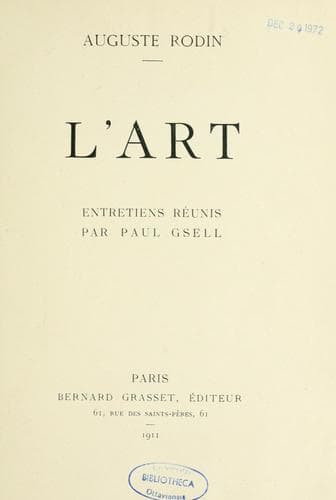
Art; Artists; Artists -- France -- Interviews; Sculpture
There are two statues by Rodin at the Musée du Luxembourg which
especially attract and hold me; _l’Age d’Airain_ (the Iron Age) and
_Saint-Jean-Baptiste_. They seem even more full of life than the others,
if that is possible. The other works of the Master which bear them
company are certainly all quivering with truth; they all produce the
impression of real flesh, they all breathe, but these move.
One day in the Master’s atelier at Meudon I told him my especial
fondness for these two figures.
“They are certainly among those in which I have carried imitative art
farthest,” he replied. “Though I have produced others whose animation is
not less striking; for example, my _Bourgeois de Calais_, my _Balzac_,
my _Homme qui marche_ (Man walking).
“And even in those of my works in which action is less pronounced, I
have always sought to give some indication of movement. I have very
rarely represented complete repose. I have always endeavored to express
the inner feelings by the mobility of the muscles.
“This is so even in my busts, to which I have often given a certain
slant, a certain obliquity, a certain expressive direction, which would
emphasize the meaning of the physiognomy.
“Art cannot exist without life. If a sculptor wishes to interpret joy,
sorrow, any passion whatsoever, he will not be able to move us unless he
first knows how to make the beings live which he evokes. For how could
the joy or the sorrow of an inert object—of a block of stone—affect us?
Now, the illusion of life is obtained in our art by good modelling and
by movement. These two qualities are like the blood and the breath of
all good work.”
[Illustration:
MAN WALKING
By Rodin
]
“Master,” I said, “you have already talked to me of modelling, and I
have noticed that since then I am better able to appreciate the
masterpieces of sculpture. I should like to ask a few questions about
movement, which, I feel, is not less important.
“When I look at your figure of the _Iron Age_, who awakes, fills his
lungs and raises high his arms; or at your _Saint John_, who seems to
long to leave his pedestal to carry abroad his words of faith, my
admiration is mixed with amazement. It seems to me that there is sorcery
in this science which lends movement to bronze. I have also studied
other _chefs-d’œuvre_ of your great predecessors; for example, _Maréchal
Ney_ and the _Marseillaise_ by Rude, the _Dance_ by Carpeaux, as well as
Barye’s wild animals, and I confess that I have never found any
satisfactory explanation for the effect which these sculptures produce
upon me. I continue to ask myself how such masses of stone and iron can
possibly seem to move, how figures so evidently motionless can yet
appear to act and even to lend themselves to violent effort.”
“As you take me for a sorcerer,” Rodin answered, “I shall try to do
justice to my reputation by accomplishing a task much more difficult for
me than animating bronze—that of explaining how I do it.
Public-domain text, read in full here on John Shaqi.
Reviews
Reviews
No reviews yet
Be the first to share your thoughts on this work.
Join the Discussion
Join the discussion
Sign in to leave a comment or review.
Sign InorCreate an account