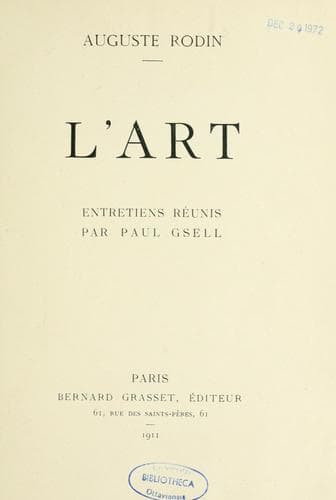
Art; Artists; Artists -- France -- Interviews; Sculpture
“Albrecht Dürer’s color is called hard and dry. It is not so at all. But
he is a German; he generalizes; his compositions are as exact as logical
constructions; his people are as solid as essential types. That is why
his drawing is so precise and his color so restrained.
“Holbein belongs to the same school. His drawing has none of the
Florentine grace; his color has none of the Venetian charm; but his line
and color have a power, a gravity, an inner meaning, which perhaps are
found in no other painter.
[Illustration:
STUDY
By Rodin
Photograph reproduced by permission of the Metropolitan Museum of Art
]
[Illustration:
STUDY FOR A FIGURE
By Rodin
Photograph reproduced by permission of the Metropolitan Museum of Art
]
“In general, it is possible to say that in artists as deliberate, as
careful as these, drawing is particularly tight and the color is as cold
as the verity of mathematics. In other artists, on the contrary, in
those who are the poets of the heart, like Raphael, Correggio, Andrea
del Sarto, line has more suppleness and color, more winning tenderness.
In others whom we call _realists_, that is to say, whose sensibility is
more exterior, in Rubens, Velasquez, Rembrandt, for example, line has a
living charm with its force and its repose, and the color sometimes
bursts into a fanfare of sunlight, sometimes fades into mist.
“So, the modes of expression of men of genius differ as much as their
souls, and it is impossible to say that in some among them drawing and
color are better or worse than in others.”
“I understand, Master; but in refusing the usual classification of
artists as draughtsmen or colorists, you do not stop to think how you
embarrass the poor critics. Happily, however, it seems to me that in
your words those who like categories may find a new method of
classification. Color and drawing, you say, are only means, and it is
the soul of the artist that it is important to know. So painters should
be grouped according to their dispositions. For example, Albrecht Dürer
with Holbein—both are logicians. Raphael, Correggio, Andrea del Sarto,
whom you have named together, make a class in which sentiment is
predominant; they are in the front rank of the elegiacs. Another class
would be composed of the masters who are interested in active existence,
in daily life, and the trio of Rubens, Velasquez and Rembrandt would be
its greatest constellation. Finally, artists such as Claude Lorraine and
Turner, who considered nature as a tissue of brilliant and fugitive
visions, would comprise a fourth group.”
Rodin smiled. “Such a classification would not be wanting in ingenuity,”
he said, “and it would be much more just than that which divides the
colorists from the draughtsmen.
[Illustration:
TRITON AND NEREID
By Rodin
Photograph reproduced by permission of the Metropolitan Museum of Art
]
[Illustration:
THE CARYATID
By Rodin
Photograph reproduced by permission of the Metropolitan Museum of Art
]
Public-domain text, read in full here on John Shaqi.
Reviews
Reviews
No reviews yet
Be the first to share your thoughts on this work.
Join the Discussion
Join the discussion
Sign in to leave a comment or review.
Sign InorCreate an account