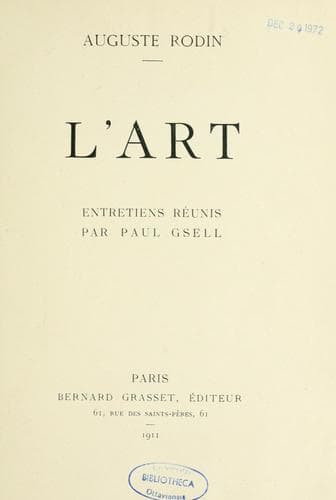
Art; Artists; Artists -- France -- Interviews; Sculpture
“Surely,” I said, “no one can contest the mental vigor of the great
painters and sculptors. But, to return to our question—is there not a
sharp line dividing art from literature which the artist should not
cross?”
“I insist that in matters which concern me I cannot stand these
limitations,” Rodin answered. “There is no rule, according to my idea,
that can prevent a sculptor from creating a beautiful work.
“What difference does it make whether it is sculpture or literature,
provided the public find profit and pleasure in it? Painting, sculpture,
literature, music are more closely related than is generally believed.
They express all the sentiments of the human soul in the light of
nature. It is only the means of expression which vary.
“But if a sculptor, by the means of his art, succeeds in suggesting
impressions which are ordinarily only procured by literature or music,
why should the world cavil? A publicist lately criticised my _Victor
Hugo_ in the Palais Royal, declaring that it was not sculpture, but
music. And he naïvely added that this work reminded him of a Beethoven
symphony. Would to Heaven that it were true!
“I do not deny, moreover, that it is useful to reflect upon the
differences which separate literary from artistic methods. First of all,
literature offers the peculiarity of being able to express ideas without
recourse to imagery. For example, it can say: _Profound reflection often
ends in inaction_, without the necessity of figuring a thoughtful woman
held in a block of stone.
“And this faculty of juggling with abstractions by means of words gives,
perhaps, to literature an advantage over other arts in the domain of
thought.
[Illustration:
BUST OF MLLE. CLAUDEL (LA PENSÉE)
By Rodin
]
“The next thing to be noticed is that literature develops stories which
have a beginning, a middle, and an end. It strings together different
events from which it draws a conclusion. It makes people act and shows
the consequences of their conduct. So the scenes that it conjures up
gain strength by their sequence, and even have no value except as they
make part of the progress of a plot.
“It is not the same with the arts of form. They never represent more
than a single phase of an action. That is why painters and sculptors are
wrong in taking subjects from writers, as they often do. The artist who
interprets a part of a story may be supposed to know the rest of the
text. His work must prop itself up on that of the writer; it only
acquires all its meaning if it is illuminated by the facts that precede
or follow it.
“When the painter Delaroche represents, after Shakespeare, or after his
pale imitator, Casimir Delavigne, the _Children of Edward_ (_les Enfants
d’Edouard_) clinging to each other, it is necessary to know, in order to
be interested, that they are the heirs to a throne, that they have been
imprisoned, and that hired murderers, sent by the usurper, are just
coming to assassinate them.
Public-domain text, read in full here on John Shaqi.
Reviews
Reviews
No reviews yet
Be the first to share your thoughts on this work.
Join the Discussion
Join the discussion
Sign in to leave a comment or review.
Sign InorCreate an account