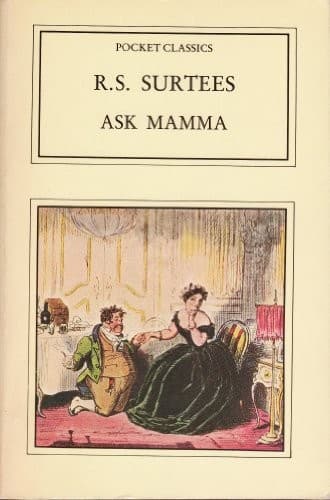
"Ask Mamma"; or, The Richest Commoner In EnglandSurtees, Robert Smith
General
"Ask Mamma"; or, The Richest Commoner In England
Surtees, Robert Smith
England -- Social life and customs -- 19th century -- Fiction; Fox hunting -- Fiction
These, Clara, Flora, and Harriet, were very pretty, and very
highly educated—that is to say, they could do everything that is
useless—play, draw, sing, dance, make wax-flowers, bead-stands,
do decorative gilding, and crochet-work; but as to knowing how
many ounces there are in a pound of tea, or how many pounds of
meat a person should eat in a day, they were utterly, entirely,
and most elegantly ignorant. Towards the close of the last
century, and at the beginning of the present one, ladies ran
entirely to domesticity, pickling, preserving, and pressing
people to eat. Corded petticoats and patent mangles long formed
the staple of a mid life woman’s conversation. Presently a new
era sprang up, which banished everything in the shape of
utilitarianism, and taught the then rising generation that the
less they knew of domestic matters the finer ladies they would
be, until we really believe the daughters of the nobility are
better calculated for wives, simply because they are generally
economically brought up, and are not afraid of losing _caste_, by
knowing what every woman ought to do. No man thinks the worse of
a woman for being able to manage her house, while few men can
afford to marry mere music-stools and embroidery frames. Mrs.
Yammerton, however, took a different view of the matter. She had
been brought up in the patent mangle and corded petticoat school,
and inwardly resolved that her daughters should know nothing of
the sort—should be “real ladies,” in the true kitchen acceptation
of the term. Hence they were mistresses of all the little
accomplishments before enumerated, which, with making calls and
drinking tea, formed the principal occupation of their lives. Not
one of them could write a letter without a copy, and were all
very uncertain in their spelling—though they knew to a day when
every King and Queen began to reign, and could spout all the
chief towns in the kingdom. Now this might have been all very
well, at least bearable, if the cockey Major had had plenty of
money to give them, but at the time they were acquiring them, the
“contrary was the case,” as the lawyers say. The Major’s
grandfather (his father died when he was young) had gone upon the
old annexation principle of buying land and buying land simply
because “it joined,” and not always having the cash to pay for it
with, our Major came into an estate (large or small, according as
the reader has more or less of his own) saddled with a good,
stout, firmly setting mortgage. Land, however, being the only
beast of burthen that does not show what it carries, our
orphan—orphan in top-boots to be sure—passed for his best, and
was speedily snapped up by the then beautiful, Italian—like Miss
Public-domain text, read in full here on John Shaqi.
Reviews
Reviews
No reviews yet
Be the first to share your thoughts on this work.
Elsewhere in the archive
Join the Discussion
Join the discussion
Sign in to leave a comment or review.
Sign InorCreate an account