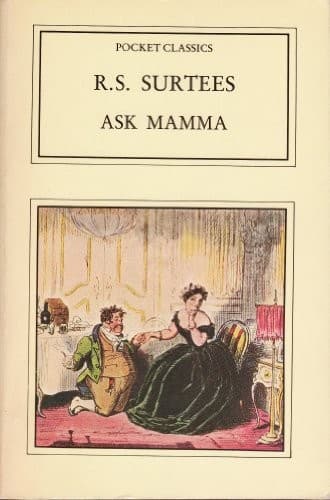
"Ask Mamma"; or, The Richest Commoner In EnglandSurtees, Robert Smith
General
"Ask Mamma"; or, The Richest Commoner In England
Surtees, Robert Smith
England -- Social life and customs -- 19th century -- Fiction; Fox hunting -- Fiction
It is true that the Major did not take a subscription in the
common acceptation of the term, but he took assistance in various
ways, such as a few days ploughing from one man, a few “bowels”
of seed-wheat from another, a few “bowels” of seed-oats from a
third, a lamb from a fourth, a pig from a fifth, added to which,
he had all the hounds walked during the summer, so that his
actual expenses were very little more than the tax. This he
jockeyed by only returning about two-thirds the number of hounds
he kept; and as twelve couple were his hunting maximum, his
taxing minimum would be about eight—eight couple—or sixteen
hounds, at twelve shillings a-piece, is nine pound twelve, for
which sum he made more noise in the papers than the Quorn, the
Belvoir, and the Cottesmore all put together. Indeed the old
adage of “great cry and little wool,” applies to packs as well as
flocks, for we never see hounds making a great “to-do” in the
papers without suspecting that they are either good for nothing,
or that the fortunate owner wants to sell them.
With regard to horses, the Major, like many people, had but one
sort—the best in England—though they were divided into two
classes, viz., hunters and draught horses. Hacks or carriage
horses he utterly eschewed. Horses must either hunt or plough
with him; nor was he above putting his hunters into the harrows
occasionally. Hence he always had a pair of efficient horses for
his carriage when he wanted them, instead of animals that were
fit to jump out of their skins at starting, and ready to slip
through them on coming home.
Clothing he utterly repudiated for carriage horses, alleging,
that people never get any work out of them after they are once
clothed.
The hunters were mostly sedate, elderly animals, horses that had
got through the “morning of life” with the foxhounds, and came to
the harriers in preference to harness. The Major was always a
buyer or an exchanger, or a mixer of both, and would generally
“advance a little” on the neighbouring job-master’s prices. Then
having got them, he recruited the veterans by care and crushed
corn, which, with cutting their tails, so altered them, that
sometimes their late groom scarcely knew them again.
Public-domain text, read in full here on John Shaqi.
Reviews
Reviews
No reviews yet
Be the first to share your thoughts on this work.
Elsewhere in the archive
Join the Discussion
Join the discussion
Sign in to leave a comment or review.
Sign InorCreate an account