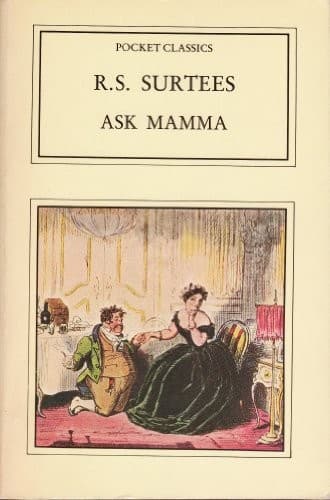
"Ask Mamma"; or, The Richest Commoner In EnglandSurtees, Robert Smith
General
"Ask Mamma"; or, The Richest Commoner In England
Surtees, Robert Smith
England -- Social life and customs -- 19th century -- Fiction; Fox hunting -- Fiction
At the period of which we are writing, the Major’s pack was
rather better than usual, being composed of the pick of three
packs,—“cries of dogs” rather—viz., the Corkycove harriers, kept
by the shoemakers of Waxley; the Bog-trotter harriers (four
couple), kept by some moor-edge miners; the Dribbleford dogs,
upon whom nobody would pay the tax; and of some two or three
couple of incurables, that had been consigned from different
kennels on condition of the Major returning the hampers in which
they came.
The Major was open to general consignments in the canine
line—Hounds, Pointers, Setters, Terriers, &c.—not being of George
the Third’s way of thinking, who used to denounce all “presents
that eat.” He would take anything; anything, at least, except a
Greyhound, an animal that he held in mortal abhorrence. What he
liked best was to get a Lurcher, for which he soon found a place
under a pear-tree.
The Major’s huntsman, old Solomon, was coachman, shepherd, groom,
and gamekeeper, as well as huntsman, and was the cockaded
gentleman who drove the ark on the occasion of our introduction.
In addition to all this, he waited at table on grand occasions,
and did a little fishing, hay-making, and gardening in the
summer. He was one of the old-fashioned breed of servants, now
nearly extinct, who passed their lives in one family and turned
their hands to whatever was wanted. The Major, whose maxim was
not to keep any cats that didn’t catch mice, knowing full well
that all gentlemen’s servants can do double the work of their
places, provided they only get paid for it, resolved, that it was
cheaper to pay one man the wages of one-and-a-half to do the work
of two men, than to keep two men to do the same quantity;
consequently, there was very little hissing at bits and
curb-chains in the Major’s establishment, the hard work of other
places being the light work, or no work at all, of his. Solomon
was the _beau idéal_ of a harrier huntsman, being, as the French
say, _d’un certain age_, quiet, patient, and a pusillanimous
rider.
Now about the subscription.
Public-domain text, read in full here on John Shaqi.
Reviews
Reviews
No reviews yet
Be the first to share your thoughts on this work.
Elsewhere in the archive
Join the Discussion
Join the discussion
Sign in to leave a comment or review.
Sign InorCreate an account