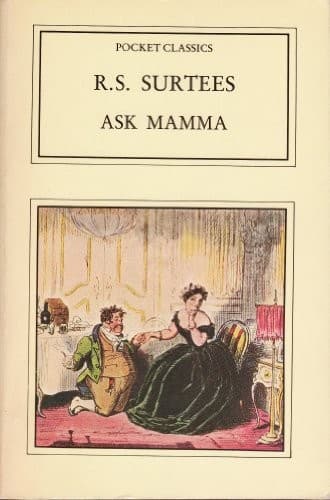
"Ask Mamma"; or, The Richest Commoner In EnglandSurtees, Robert Smith
General
"Ask Mamma"; or, The Richest Commoner In England
Surtees, Robert Smith
England -- Social life and customs -- 19th century -- Fiction; Fox hunting -- Fiction
Number four is a handsome whole coloured bright bay horse,
“Napoleon the Great,” as the Major calls him, in hopes that his
illustrious name will sell him, for of all bad tickets he ever
had, the Major thinks Nap is the worst. At starting, he is all
fire, frisk, and emulation, but before he has gone five miles, he
begins to droop, and in hunting knocks up entirely before he has
crossed half-a-dozen fields. He is a weak, watery, washy
creature, wanting no end of coddling, boiled corn, and linseed
tea. One hears of two days a-week horses, but Napoleon the Great
is a day in two weeks one. The reader will wonder how the Major
came to get such an animal, still more how he came to keep him;
above all, how he ever came to have him twice. The mystery,
however, is explained on the old bartering, huckstering,
half-and-half system. The Major got him first from Tom
Brandysneak, a low public-house-keeping leather-plater, one of
those sporting men, not sportsmen, who talk about supporting the
turf, as if they did it like the noblemen of old, upon principle,
instead of for what they can put into their own pockets; and the
Major gave Sneak an old green dog-cart, a melon frame, sixteen
volumes of the “Racing Calendar,” bound in calf, a ton of
seed-hay, fifty yards of Croggon’s asphalt roofing felt, and
three “golden sovereigns” for him. Nap was then doing duty under
the title of Johnny Raw, his calling being to appear at different
posts whenever the cruel conditions of a race required a certain
number of horses to start in order to secure the added money; but
Johnny enacted that office so often for the benefit of the
“Honourable Society of Confederated Legs,” that the stewards of
races framed their conditions for excluding him; and Johnny’s
occupation being gone, he came to the Major in manner aforesaid.
Being, however, a horse of prepossessing appearance, a good bay,
with four clean black legs, a neat well set-on head, with an
equally neat set-on tail, a flowing mane, and other &c’s, he soon
passed into the possession of young Mr. Tabberton, of Green
Linnet Hill, whose grandmamma had just given him a hundred
guineas wherewith to buy a good horse—a _real_ good one he was to
be—a hundred-guinea-one in fact. Tabberton soon took all the gay
insolence out of Johnny’s tail, and brought him back to the
Major, sadly dilapidated—a sad satire upon his former self.
Public-domain text, read in full here on John Shaqi.
Reviews
Reviews
No reviews yet
Be the first to share your thoughts on this work.
Elsewhere in the archive
Join the Discussion
Join the discussion
Sign in to leave a comment or review.
Sign InorCreate an account