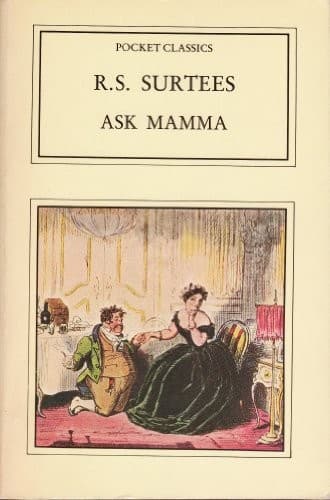
"Ask Mamma"; or, The Richest Commoner In EnglandSurtees, Robert Smith
General
"Ask Mamma"; or, The Richest Commoner In England
Surtees, Robert Smith
England -- Social life and customs -- 19th century -- Fiction; Fox hunting -- Fiction
The Major meanwhile, all energy and enthusiasm, rides gallantly
forward, for though he is no great hand among the enclosures, he
makes a good fight in the hills, especially when, as now, he
knows every yard of the country. Many’s the towl he’s had over
it, though to look at his excited face one would think this was
his first hunt. He’ll now “bet half-a-crown they kill her!” He’ll
“bet a guinea they kill her!” He’ll “bet a fi-pun note they kill
her!” He’ll “bet half the national debt they kill her!” as
Dainty, and Lovely, and Bustler, after dwelling and hesitating
over some rushy ground, at length proclaim the scent beyond.
Away they all sweep like the careering wind. On follow the field
in glorious excitement. A flock of black-faced sheep next foil
the ground—sheep as wild, if not wilder, than the animal the
hounds are pursuing. We often think, when we see these
strong-scented animals scouring the country, that a good beast of
chase has been overlooked for the stag. Why shouldn’t an old wiry
black-faced tup, with his wild sparkling eyes and spiral horns,
afford as good a run as a home-fed deer? Start the tup in his own
rough region, and we will be bound to say he will give the hounds
and their followers a scramble. The Major now denounces the
flying flock—“Oh, those nasty muttons!” exclaims he, “bags of
bone rather, for they won’t be meat these five years. Wonder how
any sane people can cultivate such animals.”
The hounds hunt well through the difficulty, or the Major would
have been more savage still. On they go, yapping and towling, and
howling as before, the Major’s confidence in a kill increasing at
every stride.
The terror-striking shouts that greeted poor puss’s exit from the
bush, have had the effect as well of driving her out of her
country as of pressing her beyond her strength; and she has no
sooner succeeded in placing what she hopes is a comfortable
distance between herself and her pursuers, than she again has
recourse to those tricks with which nature has so plentifully
endowed her. Sinking the hill she makes for the little enclosed
allotments below, and electing a bare fallow—bare, except in the
matter of whicken grass—she steals quietly in, and commences her
performances on the least verdant part of it.
Public-domain text, read in full here on John Shaqi.
Reviews
Reviews
No reviews yet
Be the first to share your thoughts on this work.
Elsewhere in the archive
Join the Discussion
Join the discussion
Sign in to leave a comment or review.
Sign InorCreate an account