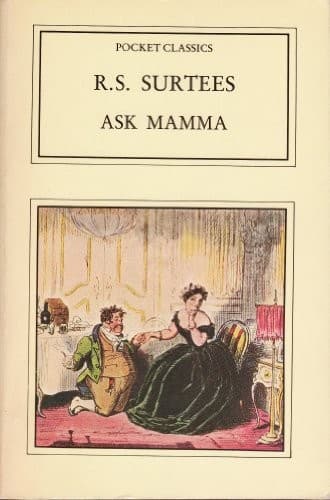
"Ask Mamma"; or, The Richest Commoner In EnglandSurtees, Robert Smith
General
"Ask Mamma"; or, The Richest Commoner In England
Surtees, Robert Smith
England -- Social life and customs -- 19th century -- Fiction; Fox hunting -- Fiction
Mrs. Margerum entered upon her duties at Pangburn Park, with the
greatest plausibility, for not content with the usual finding
fault with all the acts of her predecessors, she absolutely
“reformed the butcher’s bills,” reducing them nearly a pound
a-week below what they had previously been, and showed great
assiduity in sending in all the little odds and ends of good
things that went out. To be sure the hams disappeared rather
quickly, but then they _do_ cut so to waste in frying, and the
cows went off in their milk, but cows are capricious things, and
Mrs. Hindmarch and she had a running account in the butter and
egg line, Mrs. Hindmarch accommodating her with a few pounds of
butter and a few score of eggs when Sir Moses had company, Mrs.
Margerum repaying her at her utmost convenience, receiving the
difference in cash, the repayment being always greatly in excess
of the advance. Still as Mrs. Margerum permitted no waste, and
allowed no one to rob but herself, the house appeared to be
economically kept, and if Sir Moses didn’t think that she was a
“charming woman,” he at all events considered he was a most
fortunate man, and felt greatly indebted to Lord Oilcake’s cook
for recommending her—“dom’d if he didn’t.”
But though Mrs. Margerum kept the servants well up to their tea
and sugar allowances, she granted them every indulgence in the
way of gadding about, and also in having their followers,
provided the followers didn’t eat, by which means she kept the
house quiet, and made her reign happy and prosperous.
Being in full power when Mr. Bankhead came, she received him with
the greatest cordiality, and her polite offer of having his
clothes washed in Sir Moses’s laundry being accepted, of course
she had nothing to fear from Mr. Bankhead. And so they became as
they ought to be, very good friends—greatly to Sir Moses’s
advantage.
Now for the out-door department of Sir Moses’s ménage. The
hunting establishment was of the rough and ready order, but still
the hounds showed uncommon sport, and if the horses were not
quite up to the mark, that perhaps was all in favour of the
hounds. The horses indeed were of a very miscellaneous order—all
sorts, all sizes, all better in their wind than on their
legs—which were desperately scored and iron-marked. Still the
cripples could go when they were warm, and being ridden by men
whose necks were at a discount, they did as well as the best.
There is nothing like a cheap horse for work.
Public-domain text, read in full here on John Shaqi.
Reviews
Reviews
No reviews yet
Be the first to share your thoughts on this work.
Elsewhere in the archive
Join the Discussion
Join the discussion
Sign in to leave a comment or review.
Sign InorCreate an account