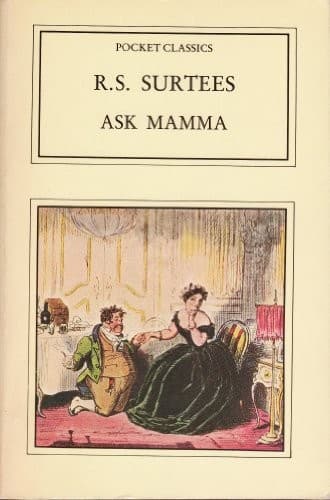
"Ask Mamma"; or, The Richest Commoner In EnglandSurtees, Robert Smith
General
"Ask Mamma"; or, The Richest Commoner In England
Surtees, Robert Smith
England -- Social life and customs -- 19th century -- Fiction; Fox hunting -- Fiction
It will be evident to our fair friends that the Archer bold had
the advantage over the lady, in having all his raiment in town,
while she had all hers, at least all the pick of hers,—her
first-class things,—in the country. Now every body knows that
what looks very smart in the country looks very seedy in London,
and though the country cousins of life do get their new things to
take back with them there, yet regular town-comers have theirs
ready, or ready at all events to try on against they arrive, and
so have the advantage of looking like civilised people while they
are up. London, however, is one excellent place for remedying any
little deficiency of any sort, at least if a person has only
either money or credit, and a lady or gentleman can soon be
rigged out by driving about to the different shops.
Now it so happened that Miss Willing had nothing of her own in
town, that she felt she would be doing herself justice to appear
before Billy in, and had omitted bringing her ladyship’s keys,
whereby she might have remedied the deficiency out of that
wardrobe; however, with such a commission as she held, there
could be no difficulty in procuring the loan of whatever was
wanted from her ladyship’s milliner. We may mention that on
accepting office under Lady Delacey, Miss Willing, with the
greatest spirit of fairness, had put her ladyship’s custom in
competition among three distinguished modistes, viz. her old
friend Madame Adelaide Banboxeney, Madame Celeste de Montmorency,
of Dover Street, and Miss Julia Freemantle, of Cowslip Street,
May Fair; and Miss Freemantle having offered the same percentage
on the bill (£15) as the other two, and £20 a year certain money
more than Madame Banboxeney, and £25 more than Madame Celeste de
Montmorency, Miss Freemantle had been duly declared the
purchaser, as the auctioneers say, and in due time (as soon as a
plausible quarrel could be picked with the then milliner) was in
the enjoyment of a very good thing, for though the Countess
Delacey, in the Gilpin-ian spirit of the age, tried to tie Miss
Freemantle down to price, yet she overlooked the extras, the
little embroidery of a bill, if we may so call it, such as four
pound seventeen and sixpence for a buckle, worth perhaps the odd
silver, and the surreptitious lace, at no one knows what, so long
as they were not all in one item, and were cleverly scattered
about the bill in broken sums, just as the lady thought the
ribbon dear at a shilling a yard, but took it when the
counter-skipper replied, “S’pose, marm, then, we say thirteen
pence”—Miss Willing having had a consultation with Miss
Freemantle as to the most certain means of quashing the Countess
Public-domain text, read in full here on John Shaqi.
Reviews
Reviews
No reviews yet
Be the first to share your thoughts on this work.
Join the Discussion
Join the discussion
Sign in to leave a comment or review.
Sign InorCreate an account