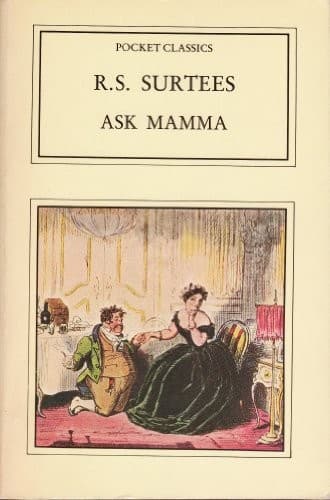
"Ask Mamma"; or, The Richest Commoner In EnglandSurtees, Robert Smith
General
"Ask Mamma"; or, The Richest Commoner In England
Surtees, Robert Smith
England -- Social life and customs -- 19th century -- Fiction; Fox hunting -- Fiction
The melancholy catastrophe with which we closed our last chapter
found our hero at a preparatory school, studying for Eton,
whither papa proposed sending him on the old principle of getting
him into good society; though we believe it is an experiment that
seldom succeeds. The widow, indeed, took this view of the matter,
for her knowledge of high life caused her to know that though a
“proud aristocracy” can condescend, and even worship wealth, yet
that they are naturally clannish and exclusive, and tenacious of
pedigree. In addition to this, Mrs. Pringle’s experience of men
led her to think that the solemn pedantic “Greek and Latin ones,”
as she called them, who know all about Julius Cæsar coming,
“_summa diligentia_,” on the top of the diligence, were not half
so agreeable as those who could dance and sing, and knew all that
was going on in the present-day world; which, in addition to her
just appreciation of the delicate position of her son, made her
resolve not to risk him among the rising aristocracy at Eton,
who, instead of advancing, might only damage his future prospects
in life, but to send him to Paris, where, besides the three
R’s,—“reading, riting, and rithmetic,”—he would acquire all the
elegant accomplishments and dawn fresh upon the world an
unexpected meteor.
This matter being arranged, she then left Dirty Street, as she
called Doughty Street, with all the disagreeable Pringle family
espionage, and reminiscences, and migrated westward, taking up
her abode in the more congenial atmosphere of Curtain Crescent,
Pimlico, or Belgravia, as, we believe the owners of the houses
wish to have it called. Here she established herself in a very
handsome, commodious house, with porticoed doorway and balconied
drawing-rooms—every requisite for a genteel family in short; and
such a mansion being clearly more than a single lady required,
she sometimes accommodated the less fortunate, through the medium
of a house-agent, though both he and she always begged it to be
distinctly understood that she did not let lodgings, but
“apartments;” and she always requested that the consideration
might be sent to her in a sealed envelope by the occupants, in
the same manner as she transmitted them the bill. So she managed
to make a considerable appearance at a moderate expense, it being
only in the full season that her heart yearned towards the
houseless, when of course a high premium was expected. There is
nothing uncommon in people letting their whole houses; so why
should there be anything strange in Mrs. Pringle occasionally
letting a part of one? Clearly nothing. Though Mrs. Joe did say
she had turned a lodging-house keeper, she could not refrain from
Public-domain text, read in full here on John Shaqi.
Reviews
Reviews
No reviews yet
Be the first to share your thoughts on this work.
Join the Discussion
Join the discussion
Sign in to leave a comment or review.
Sign InorCreate an account