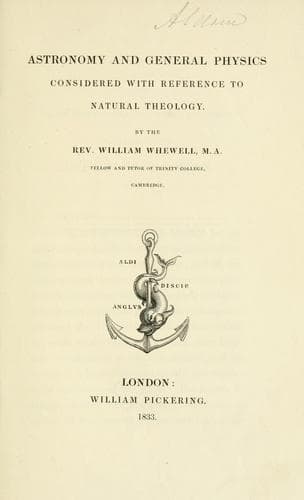
Astronomy and General Physics Considered with Reference to Natural TheologyWhewell, William
Religion
Astronomy and General Physics Considered with Reference to Natural Theology
Whewell, William
Astronomy; Cosmic physics; Natural theology
And if in this way we suppose a planet to be produced, what sort
of a body would it be?--something, it may be presumed, resembling
a large meteoric stone. How comes this mass to be covered with
motion and organization, with life and happiness? What primitive
cause stocked it with plants and animals, and produced all the
wonderful and subtle contrivances which we find in their structure,
all the wide and profound mutual dependencies which we trace in
their economy? Was man, with his thought and feeling, his powers
and hopes, his will and conscience, also produced as an ultimate
result of the condensation of the solar atmosphere? Except we allow
a prior purpose and intelligence presiding over this material
“primitive cause,” how irreconcilable is it with the evidence which
crowds in upon us from every side!
3. In the next place, we may observe concerning this hypothesis,
that it carries us back to the beginning of the present system
of things; but that it is impossible for our reason to stop at
the point thus presented to it. The sun, the earth, the planets,
the moons were brought into their present order out of a previous
state, and, as is supposed in the theory, by the natural operation
of laws. But how came that previous state to exist? We are
compelled to suppose that it, in like manner, was educed from a
still prior state of things; and this, again, must have been the
result of a condition prior still. Nor is it possible for us to
find, in the tenets of the nebular hypothesis, any resting place or
satisfaction for the mind. The same reasoning faculty, which seeks
for the origin of the present system of things, and is capable
of assenting to, or dissenting from the hypothesis propounded
by Laplace as an answer to this inquiry, is necessarily led to
seek, in the same manner, for the origin of any previous system
of things, out of which the present may appear to have grown: and
must pursue this train of inquiries unremittingly, so long as the
answer which it receives describes a mere assemblage of matter and
motion; since it would be to contradict the laws of matter and the
nature of motion, to suppose such an assemblage to be the _first_
condition.
Public-domain text, read in full here on John Shaqi.
Reviews
Reviews
No reviews yet
Be the first to share your thoughts on this work.
Elsewhere in the archive
Join the Discussion
Join the discussion
Sign in to leave a comment or review.
Sign InorCreate an account