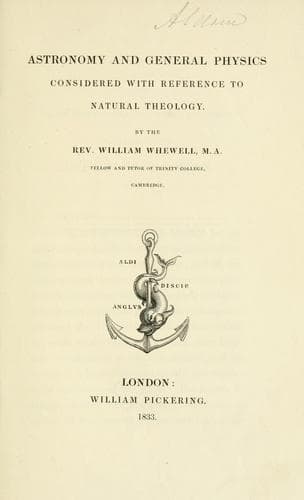
Astronomy and General Physics Considered with Reference to Natural TheologyWhewell, William
Religion
Astronomy and General Physics Considered with Reference to Natural Theology
Whewell, William
Astronomy; Cosmic physics; Natural theology
It may easily be conceived that all the primary motions of a system
so produced would be nearly circular, nearly in the plane of the
original equator of the solar rotation, and in the direction of
that rotation. Reasons are offered also to show that the motions
of the satellites thus produced and the motions of rotation of the
planets must be in the same direction. And thus it is held that the
hypothesis accounts for the most remarkable circumstances in the
structure of the solar system: namely, the motions of the planets
in the same direction, and almost in the same plane; the motions
of the satellites in the same direction as those of the planets;
the motions of rotation of these different bodies still in the same
direction as the other motions, and in planes not much different;
the small eccentricity of the orbits of the planets, upon which
condition, along with some of the preceding ones, the stability of
the system depends; and the position of the source of light and
heat in the centre of the system.
It is not necessary for the purpose, nor suitable to the plan
of the present treatise, to examine, on physical grounds, the
probability of the above hypothesis. It is proposed by its author,
with great diffidence, as a conjecture only. We might, therefore,
very reasonably put off all discussion of the bearings of this
opinion upon our views of the government of the world, till the
opinion itself should have assumed a less indistinct and precarious
form. It can be no charge against our doctrines, that there is
a difficulty in reconciling with them arbitrary guesses and
half-formed theories. We shall, however, make a few observations
upon this _nebular hypothesis_, as it may be termed.
2. If we grant, for a moment, the hypothesis, it by no means proves
that the solar system was formed without the intervention of
intelligence and design. It only transfers our view of the skill
exercised, and the means employed, to another part of the work.
For, how came the sun and its atmosphere to have such materials,
such motions, such a constitution, that these consequences
followed from their primordial condition? How came the parent
vapour thus to be capable of coherence, separation, contraction,
solidification? How came the laws of its motion, attraction,
repulsion, condensation, to be so fixed, as to lead to a beautiful
and harmonious system in the end? How came it to be neither too
fluid nor too tenacious, to contract neither too quickly nor too
slowly, for the successive formation of the several planetary
bodies? How came that substance, which at one time was a luminous
vapour, to be at a subsequent period, solids and fluids of many
various kinds? What but design and intelligence prepared and
tempered this previously existing element, so that it should by its
natural changes produce such an orderly system?
Public-domain text, read in full here on John Shaqi.
Reviews
Reviews
No reviews yet
Be the first to share your thoughts on this work.
Elsewhere in the archive
Join the Discussion
Join the discussion
Sign in to leave a comment or review.
Sign InorCreate an account