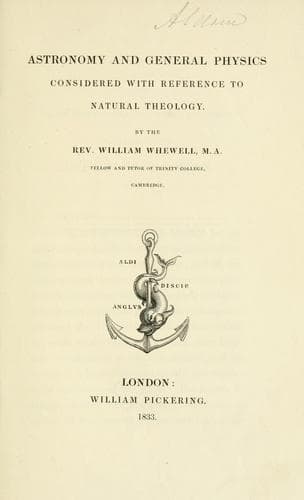
Astronomy and General Physics Considered with Reference to Natural TheologyWhewell, William
Religion
Astronomy and General Physics Considered with Reference to Natural Theology
Whewell, William
Astronomy; Cosmic physics; Natural theology
Innumerable questions of the same kind might be asked, and the
conclusion to be drawn is, that every new physical theory which
we include in our view of the universe, involves us in new
difficulties and perplexities, if we try to erect it into an
ultimate and final account of the existence and arrangement of
the world in which we live. With the evidence of such theories,
considered as scientific generalizations of ascertained facts,
with their claims to a place in our natural philosophy, we have
here nothing to do. But if they are put forwards as a disclosure
of the ultimate cause of that which occurs, and as superseding
the necessity of looking further or higher; if they claim a place
in our Natural Theology, as well as our Natural Philosophy;
we conceive that their pretensions will not bear a moment’s
examination.
Leaving then to other persons and to future ages to decide upon the
scientific merits of the nebular hypothesis, we conceive that the
final fate of this opinion cannot, in sound reason, affect at all
the view which we have been endeavouring to illustrate;--the view
of the universe as the work of a wise and good Creator. Let it be
supposed that the point to which this hypothesis leads us, is the
ultimate point of physical science: that the farthest glimpse we
can obtain of the material universe by our natural faculties, shows
it to us occupied by a boundless abyss of luminous matter: still we
ask, how space came to be thus occupied, how matter came to be thus
luminous? If we establish by physical proofs, that the first fact
which can be traced in the history of the world, is that “there
was light;” we shall still be led, even by our natural reason,
to suppose that before this could occur, “God said, let there be
light.”
CHAPTER VIII.
_The Existence of a Resisting Medium in the Solar System._
The question of a _plenum_ and a _vacuum_ was formerly much
debated among those who speculated concerning the constitution of
the universe; that is, they disputed whether the celestial and
terrestrial spaces are absolutely full, each portion being occupied
by some matter or other; or whether there are, between and among
the material parts of the world, empty spaces free from all matter,
however rare. This question was often treated by means of abstract
conceptions and _à priori_ reasonings; and was sometimes considered
as one in which the result of the struggle between rival systems of
philosophy, the Cartesian and Newtonian for instance, was involved.
It was conceived by some that the Newtonian doctrine of the motions
of the heavenly bodies, according to mechanical laws, required
that the space in which they moved should be, absolutely and
metaphysically speaking, a vacuum.
Public-domain text, read in full here on John Shaqi.
Reviews
Reviews
No reviews yet
Be the first to share your thoughts on this work.
Elsewhere in the archive
Join the Discussion
Join the discussion
Sign in to leave a comment or review.
Sign InorCreate an account