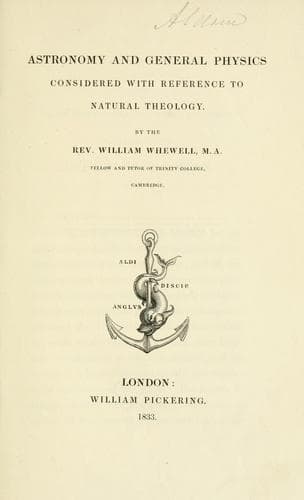
Astronomy and General Physics Considered with Reference to Natural TheologyWhewell, William
Religion
Astronomy and General Physics Considered with Reference to Natural Theology
Whewell, William
Astronomy; Cosmic physics; Natural theology
If a man were, by some extraordinary event, to find himself in a
remote and unknown country, so entirely strange to him that he
did not know whether there existed in it any law or government at
all; he might in no long time ascertain whether the inhabitants
were controlled by any superintending authority; and with a little
attention he might determine also whether such authority were
exercised with a prudent care for the happiness and well-being
of its subjects, or without any regard and fitness to such ends;
whether the country were governed by laws at all, and whether the
laws were good. And according to the laws which he thus found
prevailing, he would judge of the sagacity, and the purposes of the
legislative power.
By observing the laws of the material universe and their operation,
we may hope, in a somewhat similar manner, to be able to direct
our judgment concerning the government of the universe: concerning
the mode in which the elements are regulated and controlled, their
effects combined and balanced. And the general tendency of the
results thus produced may discover to us something of the character
of the power which has legislated for the material world.
We are not to push too far the analogy thus suggested. There is
undoubtedly a wide difference between the circumstances of man
legislating for man, and God legislating for matter. Still we
shall, it will appear, find abundant reason to admire the wisdom
and the goodness which have established _the Laws of Nature_,
however rigorously we may scrutinize the import of this expression.
CHAPTER II.
_On Laws of Nature._
When we speak of material nature as being governed by _laws_, it
is sufficiently evident that we use the term in a manner somewhat
metaphorical. The laws to which man’s attention is primarily
directed are _moral_ laws; rules laid down for his actions; rules
for the conscious actions of a person; rules which, as a matter
of possibility, he may obey or may transgress; the latter event
being combined, not with an impossibility, but with a penalty. But
the _Laws of Nature_ are something different from this; they are
rules for that which _things_ are to do and suffer; and this by
no consciousness or will of theirs. They are rules describing the
mode in which things _do_ act; they are invariably obeyed; their
transgression is not punished, it is excluded. The language of a
moral law is, man _shall_ not kill; the language of a Law of Nature
is, a stone _will_ fall to the earth.
These two kinds of laws direct the actions of persons and of
things, by the sort of control of which persons and things are
respectively susceptible; so that the metaphor is very simple; but
it is proper for us to recollect that it is a metaphor, in order
that we may clearly apprehend what is implied in speaking of the
Laws of Nature.
Public-domain text, read in full here on John Shaqi.
Reviews
Reviews
No reviews yet
Be the first to share your thoughts on this work.
Join the Discussion
Join the discussion
Sign in to leave a comment or review.
Sign InorCreate an account