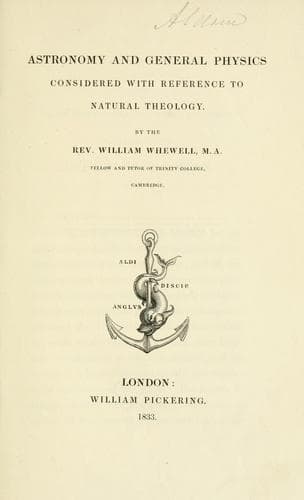
Astronomy and General Physics Considered with Reference to Natural TheologyWhewell, William
Religion
Astronomy and General Physics Considered with Reference to Natural Theology
Whewell, William
Astronomy; Cosmic physics; Natural theology
This result is true, however small be the velocity lost by
resistance; the only difference being, that when the resistance
is small, the time requisite to extinguish the whole motion will
be proportionally longer. In all cases the times which come under
our consideration in problems of this kind, are enormous to common
apprehension. Thus Encke’s comet, according to the results of
the observations already made, will lose, in ten revolutions, or
thirty-three years, less than one thousandth of its velocity:
and if this law were to continue, the velocity would not be
reduced to one-half its present value in less than seven thousand
revolutions or twenty-three thousand years. If Jupiter were to
lose one-millionth of his velocity in a million years, (which,
as has been seen, is far more than can be considered in any way
probable,) he would require seventy millions of years to lose
one-thousandth of the velocity; and a period seven hundred times as
long to reduce the velocity to one-half. These are periods of time
which quite overwhelm the imagination; and it is not pretended that
the calculations are made with any pretensions to accuracy. But
at the same time it is beyond doubt that though the intervals of
time thus assigned to these changes are highly vague and uncertain,
the changes themselves must, sooner or later, take place, in
consequence of the existence of the resisting medium. Since there
is such a retarding force perpetually acting, however slight it
be, it must in the end destroy all the celestial motions. It may
be millions of millions of years before the earth’s retardation
may perceptibly affect the apparent motion of the sun; but still
the day will come (if the same Providence which formed the system,
should permit it to continue so long) when this cause will entirely
change the length of our year and the course of our seasons, and
finally stop the earth’s motion round the sun altogether. The
smallness of the resistance, however small we choose to suppose it,
does not allow us to escape this certainty. There is a resisting
medium; and, therefore, the movements of the solar system cannot go
on for ever. The moment such a fluid is ascertained to exist, the
eternity of the movements of the planets becomes as impossible as a
perpetual motion on the earth.
Public-domain text, read in full here on John Shaqi.
Reviews
Reviews
No reviews yet
Be the first to share your thoughts on this work.
Elsewhere in the archive
Join the Discussion
Join the discussion
Sign in to leave a comment or review.
Sign InorCreate an account