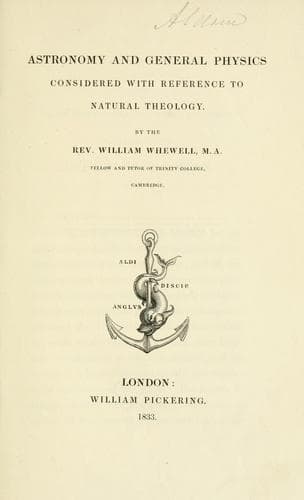
Astronomy and General Physics Considered with Reference to Natural TheologyWhewell, William
Religion
Astronomy and General Physics Considered with Reference to Natural Theology
Whewell, William
Astronomy; Cosmic physics; Natural theology
3. The vast periods which are brought under our consideration
in tracing the effects of the resisting medium, harmonize with
all that we learn of the constitution of the universe from
other sources. Millions, and millions of millions of years are
expressions that at first sight appear fitted only to overwhelm and
confound all our powers of thought; and such numbers are no doubt
beyond the limits of any thing which we distinctly conceive. But
our powers of conception are suited rather to the wants and uses
of common life, than to a complete survey of the universe. It is in
no way unlikely that the whole duration of the solar system should
be a period immeasurably great in our eyes, though demonstrably
finite. Such enormous numbers have been brought under our notice
by all the advances we have made in our knowledge of nature. The
smallness of the objects detected by the microscope and of their
parts;--the multitude of the stars which the best telescopes of
modern times have discovered in the sky;--the duration assigned
to the globe of the earth by geological investigation;--all these
results require for their probable expression, numbers, which so
far as we see, are on the same gigantic scale as the number of
years in which the solar system will become entirely deranged.
Such calculations depend in some degree on our relation to the
vast aggregate of the works of our Creator; and no person who is
accustomed to meditate on these subjects will be surprised that
the numbers which such an occasion requires should oppress our
comprehension. No one who has dwelt on the thought of a universal
Creator and Preserver, will be surprised to find the conviction
forced upon the mind by every new train of speculation, that viewed
in reference to Him, our space is a point, our time a moment, our
millions a handful, our permanence a quick decay.
Our knowledge of the vast periods, both geological and
astronomical, of which we have spoken, is most slight. It is in
fact little more than that such periods exist; that the surface of
the earth has, at wide intervals of time, undergone great changes
in the disposition of land and water, and in the forms of animal
life; and that the motions of the heavenly bodies round the sun
are affected, though with inconceivable slowness, by a force which
must end by deranging them altogether. It would therefore be rash
to endeavour to establish any analogy between the periods thus
disclosed; but we may observe that they _agree_ in this, that
they reduce all things to the general rule of _finite duration_.
As all the geological states of which we find evidence in the
present state of the earth, have had their termination, so also the
astronomical conditions under which the revolutions of the earth
itself proceed, involve the necessity of a future cessation of
these revolutions.
Public-domain text, read in full here on John Shaqi.
Reviews
Reviews
No reviews yet
Be the first to share your thoughts on this work.
Elsewhere in the archive
Join the Discussion
Join the discussion
Sign in to leave a comment or review.
Sign InorCreate an account