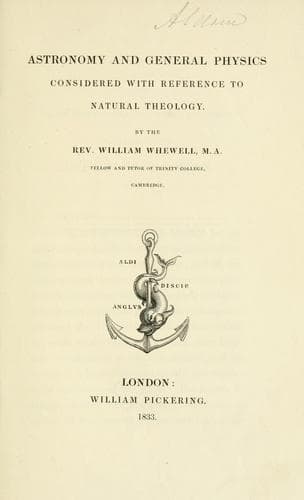
Astronomy and General Physics Considered with Reference to Natural TheologyWhewell, William
Religion
Astronomy and General Physics Considered with Reference to Natural Theology
Whewell, William
Astronomy; Cosmic physics; Natural theology
The contemplative person may well be struck by this universal law
of the creation. We are in the habit sometimes of contrasting the
transient destiny of man with the permanence of the forests, the
mountains, the ocean,--with the unwearied circuit of the sun. But
this contrast is a delusion of our own imagination; the difference
is after all but one of degree. The forest tree endures for its
centuries and then decays; the mountains crumble and change, and
perhaps subside in some convulsion of nature; the sea retires,
and the shore ceases to resound with the “everlasting” voice of
the ocean: such reflections have already crowded upon the mind of
the geologist; and it now appears that the courses of the heavens
themselves are not exempt from the universal law of decay; that not
only the rocks and the mountains, but the sun and the moon have
the sentence “to end” stamped upon their foreheads. They enjoy
no privilege beyond man except a longer respite. The ephemeron
perishes in an hour; man endures for his three score years and ten;
an empire, a nation, numbers its centuries, it may be its thousands
of years; the continents and islands which its dominion includes
have perhaps their date, as those which preceded them have had; and
the very revolutions of the sky by which centuries are numbered
will at last languish and stand still.
To dwell on the moral and religious reflections suggested by
this train of thought is not to our present purpose; but we may
observe that it introduces a _homogeneity_, so to speak, into
the government of the universe. Perpetual change, perpetual
progression, increase and diminution, appear to be the rules of
the material world, and to prevail without exception. The smaller
portions of matter which we have near us, and the larger, which
appear as luminaries at a vast distance, different as they are
in our mode of conceiving them, obey the same laws of motion;
and these laws produce the same results; in both cases motion is
perpetually destroyed, except it be repaired by some living power;
in both cases the relative rest of the parts of a material system
is the conclusion to which its motion tends.
Public-domain text, read in full here on John Shaqi.
Reviews
Reviews
No reviews yet
Be the first to share your thoughts on this work.
Elsewhere in the archive
Join the Discussion
Join the discussion
Sign in to leave a comment or review.
Sign InorCreate an account