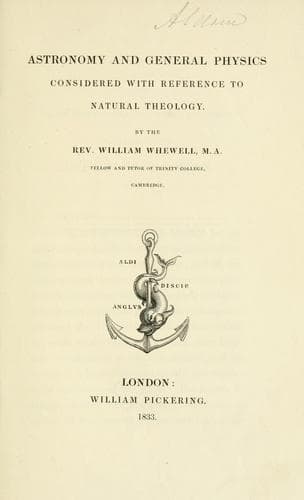
Astronomy and General Physics Considered with Reference to Natural TheologyWhewell, William
Religion
Astronomy and General Physics Considered with Reference to Natural Theology
Whewell, William
Astronomy; Cosmic physics; Natural theology
3. Another peculiar point of simplicity in the present law of
mutual attraction is this: that it makes the law of attraction for
spherical masses the same as for single particles. If particles
attract with forces which are inversely as the square of the
distance, spheres composed of such particles, will exert a force
which follows the same law. In this character the present law
is singular, among all possible laws, excepting that of the
direct distance which we have already discussed. If the law of
the gravitation of particles had been that of the inverse simple
distance, the attraction of a sphere would have been expressed by
a complex series of mathematical expressions, each representing
a simple law. It is truly remarkable that the law of the inverse
square of the distance, which appears to be selected as that of
the _masses_ of the system, and of which the mechanism is, that it
arises from the action of the _particles_ of the system, should
lead us to the same law for the action of these particles: there is
a striking _prerogative_ of simplicity in the law thus adopted.
The law of gravitation actually prevailing in the solar system has
thus great and clear advantages over any law widely different from
it; and has moreover, in many of its consequences, a simplicity
which belongs to this precise law alone. It is in many such
respects a _unique_ law; and when we consider that it possesses
several _properties_ which are _peculiar_ to it, and several
_advantages_ which may be peculiar to it, and which are certainly
nearly so; we have some ground, it would appear, to look upon its
peculiarities and its advantages as connected. For the reasons
mentioned in the last chapter, we can hardly expect to see fully
the way in which the system is benefited by the simplicity of this
law, and by the mathematical elegance of its consequences: but when
we see that it has some such beauties, and some manifest benefits,
we may easily suppose that our ignorance and limited capacity alone
prevent our seeing that there are, for the selection of this law of
force, reasons of a far more refined and comprehensive kind than
we can distinctly apprehend.
4. But before quitting this subject we may offer a few further
observations on the question, whether gravitation and the law of
gravitation be _necessary_ attributes of matter. We have spoken of
the selection of this law, but is it selected? Could it have been
otherwise? Is not the force of attraction a necessary consequence
of the fundamental properties of matter?
This is a question which has been much agitated among the followers
of Newton. Some have maintained, as Cotes, that gravity is an
inherent property of all matter; others, with Newton himself, have
considered it as an appendage to the essential qualities of matter,
and have proposed hypotheses to account for the mode in which its
effects are produced.
Public-domain text, read in full here on John Shaqi.
Reviews
Reviews
No reviews yet
Be the first to share your thoughts on this work.
Elsewhere in the archive
Join the Discussion
Join the discussion
Sign in to leave a comment or review.
Sign InorCreate an account