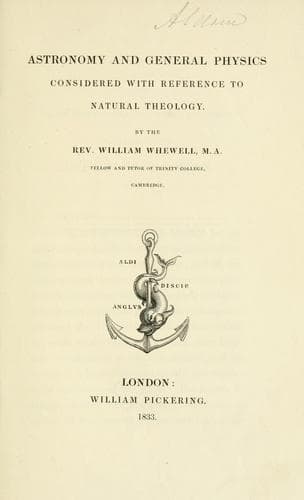
Astronomy and General Physics Considered with Reference to Natural TheologyWhewell, William
Religion
Astronomy and General Physics Considered with Reference to Natural Theology
Whewell, William
Astronomy; Cosmic physics; Natural theology
2. Among _inverse_ laws of the distance, (that is, those according
to which the force diminishes as the distance from the origin of
force increases,) all which diminish the central force faster than
the _cube_ of the distance increases are inadmissible, because they
are incompatible with the permanent revolution of a planet. Under
such laws it would follow, that a planet would describe a spiral
line about the sun, and would either approach nearer and nearer to
him perpetually, or perpetually go further and further off: nearly
as a stone at the end of a string, when the string is whirled
round, and is allowed to wrap round the hand, or to unwrap from it,
approaches to or recedes from the hand.
If we endeavour to compare the law of the inverse square of
the distance, which really regulates the central force, with
other laws, not obviously inadmissible, as for instance, the
inverse simple ratio of the distance, a considerable quantity
of calculation is found to be necessary in order to trace the
results, and especially the perturbations in the two cases. The
perturbations in the supposed case have not been calculated;
such a calculation being a process so long and laborious that it
is never gone through, except for the purpose of comparing the
results of theory with those of observation, as we can do with
regard to the law of inverse square. We can only say, therefore,
that the stability of the system, and the moderate limits of the
perturbations, which we know to be secured by the existing law,
would not, so far as we know, be obtained by any different law.
Without going into further examination of the subject, we may
observe that there are some circumstances in which the present
system has a manifest superiority in its simplicity over the
condition which would have belonged to it if the force had followed
any other law. Thus, with the present law of gravitation the
planets revolve, returning perpetually on the same track, very
nearly. The earth describes an oval, in consequence of which motion
she is nearer to the sun in our winter than in our summer by about
one-thirtieth part of the whole distance. And, as the matter now
is, the nearest approach to the sun, and the farthest recess
from him, occur always at the same points of the orbit. There is
indeed a slight alteration in these points arising from disturbing
forces, but this is hardly sensible in the course of several ages.
Now if the force had followed any other law, we should have had
the earth running perpetually on a new track. The greatest and
least distances would have occurred at different parts in every
successive revolution. The orbit would have perpetually intersected
and been interlaced with the path described in former revolutions;
and the simplicity and regularity which characterizes the present
motion would have been quite wanting.
Public-domain text, read in full here on John Shaqi.
Reviews
Reviews
No reviews yet
Be the first to share your thoughts on this work.
Elsewhere in the archive
Join the Discussion
Join the discussion
Sign in to leave a comment or review.
Sign InorCreate an account