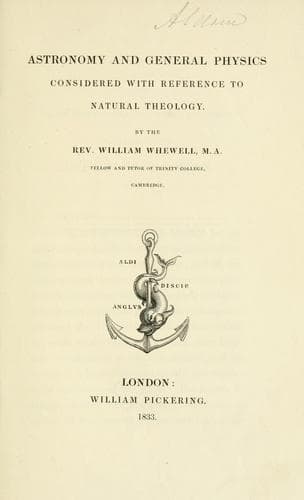
Astronomy and General Physics Considered with Reference to Natural TheologyWhewell, William
Religion
Astronomy and General Physics Considered with Reference to Natural Theology
Whewell, William
Astronomy; Cosmic physics; Natural theology
Buffon then argues, that there can be no such additional fraction
of the force, following a different law, as Clairault supposes: for
what, he asks, is there to determine the magnitude of the fraction
to one amount rather than another? why should nature select for it
any particular magnitude? To this it is replied, that, whether we
can explain the fact or not, nature does select certain magnitudes
in preference to others: that where we ascertain she does this,
we are not to deny the fact because we cannot assign the grounds
of her preference. What is there, it is asked, to determine the
magnitude of the whole force at any fixed distance? We cannot tell;
yet the force is of a certain definite intensity and no other.
Finally, Clairault observes, that we have, in cohesion, capillary
attraction, and various other cases, examples of forces varying
according to other laws than the inverse square; and that therefore
this cannot be the only possible law.
The discrepancy between observation and theory which gave rise to
this controversy was removed, as has been already stated, by a more
exact calculation: and thus, as Laplace observes, in this case
the metaphysician turned out to be right and the mathematician to
be wrong. But most persons, probably, who are familiar with such
trains of speculation, will allow, that Clairault had the best of
the argument, and that the attempts to show the law of gravitation
to be necessarily what it is, are fallacious and unsound.
8. We may observe, however, that the law of gravitation according
to the inverse square of the distance, which thus regulates the
motions of the solar system, is not confined to that province of
the universe, as has been shown by recent researches. It appears
by the observations and calculations of Sir John Herschel, that
several of the stars, called _double stars_, consist of a pair of
luminous bodies which revolve above each other in ellipses, in such
a manner as to show that the force, by which they are attracted
to each other, varies according to the law of the inverse square.
We thus learn a remarkable fact concerning bodies which seemed so
far removed that no effort of our science could reach them; and we
find that the same law of mutual attraction which we have before
traced to the farthest bounds of the solar system, prevails also
in spaces at a distance compared with which the orbit of Saturn
shrinks into a point. The establishment of such a truth certainly
suggests, as highly probable, the prevalence of this law among
all the bodies of the universe. And we may therefore suppose, that
the same ordinance which gave to the parts of our system that rule
by which they fulfil the purposes of their creation, impressed
the same rule on the other portions of matter which are scattered
in the most remote parts of the universe; and thus gave to their
movements the same grounds of simplicity and harmony which we find
reason to admire, as far as we can acquire any knowledge of our own
Public-domain text, read in full here on John Shaqi.
Reviews
Reviews
No reviews yet
Be the first to share your thoughts on this work.
Elsewhere in the archive
Join the Discussion
Join the discussion
Sign in to leave a comment or review.
Sign InorCreate an account