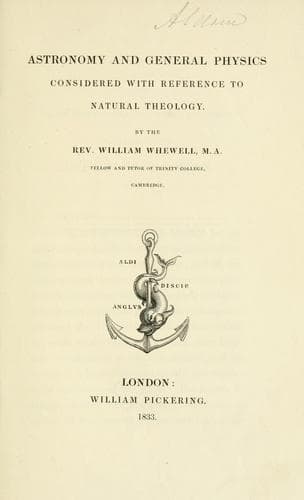
Astronomy and General Physics Considered with Reference to Natural TheologyWhewell, William
Religion
Astronomy and General Physics Considered with Reference to Natural Theology
Whewell, William
Astronomy; Cosmic physics; Natural theology
more immediate neighbourhood.
CHAPTER XI.
_The Laws of Motion._
We shall now make a few remarks on the general Laws of Motion by
which all mechanical effects take place. Are we to consider these
as instituted laws? and if so, can we point out any of the reasons
which we may suppose to have led to the selection of those laws
which really exist?
The observations formerly made concerning the inevitable narrowness
and imperfection of our conclusions on such subjects, apply here,
even more strongly than in the case of the law of gravitation. We
can hardly conceive matter divested of these laws; and we cannot
perceive or trace a millionth part of the effects which they
produce. We cannot, therefore, expect to go far in pointing out the
advantages of these laws such as they now obtain.
It would be easy to show that the fundamental laws of motion, in
whatever form we state them, possess a very preeminent simplicity,
compared with almost all others, which we might imagine as
existing. This simplicity has indeed produced an effect on men’s
minds which, though delusive, appears to be very natural; several
writers have treated these laws as self-evident, and necessarily
flowing from the nature of our conceptions. We conceive that this
is an erroneous view, and that these laws are known to us to be
what they are, by experience only; that they might, so far as we
can discern, have been any others. They appear therefore to be
selected for their fitness to answer their purposes; and we may,
perhaps, be able to point out some instances in which this fitness
is apparent to us.
Newton, and many English philosophers, teach the existence of
_three_ separate fundamental laws of motion, while most of the
eminent mathematicians of France reduce these to _two_, the law
of inertia and the law that force is proportioned to velocity. As
an example of the views which we wish to illustrate, we may take
the law of inertia, which is identical with Newton’s first Law of
Motion. This law asserts, that a body at rest continues at rest,
and that a body in motion goes on moving with its velocity and
direction unchanged, except so far as it is acted on by extraneous
forces.[24]
We conceive that this law, simple and universal as it is, cannot
be shown to be necessarily true. It might be difficult to discuss
this point in general terms with any clearness; but let us take
the only example which we know of a motion absolutely uniform, in
consequence of the absence of any force to accelerate or retard
it;--this motion is the rotation of the earth on its axis.
Public-domain text, read in full here on John Shaqi.
Reviews
Reviews
No reviews yet
Be the first to share your thoughts on this work.
Elsewhere in the archive
Join the Discussion
Join the discussion
Sign in to leave a comment or review.
Sign InorCreate an account