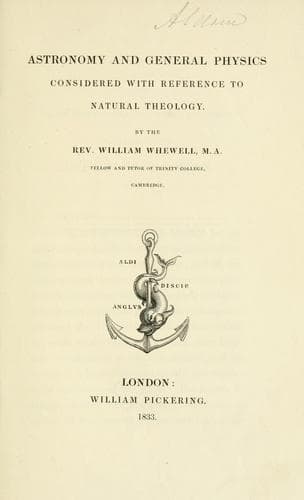
Astronomy and General Physics Considered with Reference to Natural TheologyWhewell, William
Religion
Astronomy and General Physics Considered with Reference to Natural Theology
Whewell, William
Astronomy; Cosmic physics; Natural theology
but experience, under proper circumstances, can inform us whether
bodies, abstracting from external agency, do move according to
such a rule. We find that they do so, we learn that all diminution
of their speed which ever takes place, can be traced to external
causes. Contrary to all that men had guessed, motion appears to
be of itself endless and unwearied. In order to account for the
unalterable permanence of the length of our day, all that is
requisite is to show that there is no let or hindrance in the way
of the earth’s rotation;--no resisting medium or alteration of
size,--she “spinning _sleeps_” on her axle, as the poet expresses
it, and may go on sleeping with the same regularity for ever, so
far as the experimental properties of motion are concerned.
Such is the necessary consequence of the first law of motion;
but the law itself has no necessary existence, so far as we can
see. It was discovered only after various perplexities and false
conjectures of speculators on mechanics. We have learnt that it is
so, but we have not learnt, nor can any one undertake to teach us,
that it must have been so. For aught we can tell, it is one among
a thousand equally possible laws, which might have regulated the
motions of bodies.
2. But though we have thus no reason to consider this as the only
possible law, we have good reason to consider it as the best, or at
least as possessing all that we can conceive of advantage. It is
the _simplest_ conceivable of such laws. If the velocity had been
compelled to change with the time, there must have been a law of
the change, and the kind and amount of this change must have been
determined by its dependence on the time and other conditions.
This, though quite supposable, would undoubtedly have been more
complex than the present state of things. And though complexity
does not appear to embarrass the operations of the laws of nature,
and is admitted, without scruple, when there is reason for it,
simplicity is the usual character of such laws, and appears to have
been a ground of selection in the formation of the universe, as it
is a mark of beauty to us in our contemplation of it.
Public-domain text, read in full here on John Shaqi.
Reviews
Reviews
No reviews yet
Be the first to share your thoughts on this work.
Elsewhere in the archive
Join the Discussion
Join the discussion
Sign in to leave a comment or review.
Sign InorCreate an account