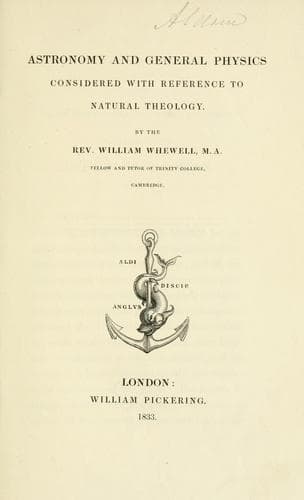
Astronomy and General Physics Considered with Reference to Natural TheologyWhewell, William
Religion
Astronomy and General Physics Considered with Reference to Natural Theology
Whewell, William
Astronomy; Cosmic physics; Natural theology
1. It is scarcely possible that discussions on such subjects
should not have a repulsive and scholastic aspect, and appear like
disputes about words rather than things. For mechanical writers
have exercised all their ingenuity so to circumscribe their notions
and so to define their terms that these fundamental truths should
be expressed in the simplest manner: the consequence of which has
been, that they have been made to assume the appearance rather
of identical assertions than of general facts of experience. But
in order to avoid this inconvenience, as far as may be, let us
take the _first law of motion_ as exemplified in a particular
case, the rotation of the earth. Of all the motions with which
we are acquainted this is alone invariable. Each day, measured
by the passages of the stars, is so precisely of the same length
that, according to Laplace’s calculations, it is impossible
that a difference of hundredth of a second of time should have
obtained between the length of the day in the earliest ages and
at the present time. Now why is this? How is this very remarkable
uniformity preserved in this particular phenomenon, while all the
other motions of the system are subject to inequalities? How is it
that in the celestial machine no retardation takes place by the
lapse of time, as would be the case in any machine which it would
be possible for human powers to construct? The answer is, that in
the earth’s revolution on her axis no cause operates to retard
the speed, like the imperfection of materials, the friction of
supports, the resistance of the ambient medium; impediments which
cannot, in any human mechanism, however perfect, be completely
annihilated. But here we are led to ask again, why should the
speed continue the same when not affected by an extraneous cause?
Why should it not languish and decay of itself by the mere lapse
of time? That it might do so, involves no contradiction, for
it was the common, though erroneous, belief of all mechanical
speculators, to the time of Galileo. We can conceive velocity to
diminish in proceeding from a certain point of time, as easily as
we can conceive force to diminish in proceeding from a certain
point of space, which in attractive forces really occurs. But,
it is sometimes said, the _motion_ (that is the velocity) _must_
continue the same from one instant to another, for there is nothing
to change it. This appears to be taking refuge in words. We may
call the velocity, that is the speed of a body, its motion; but
we cannot, by giving it this name, make it a _thing_ which has
any _à priori_ claim to permanence, much less any self-evident
constancy. Why must the speed of a body, left to itself, continue
the same, any more than its temperature? Hot bodies grow cooler of
themselves, why should not quick bodies go slower of themselves?
Why must a body describe one thousand feet in the next second
because it has described one thousand feet in the last? Nothing
Public-domain text, read in full here on John Shaqi.
Reviews
Reviews
No reviews yet
Be the first to share your thoughts on this work.
Elsewhere in the archive
Join the Discussion
Join the discussion
Sign in to leave a comment or review.
Sign InorCreate an account