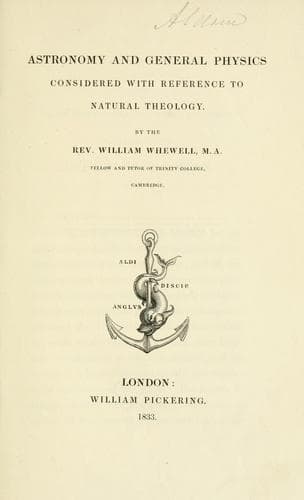
Astronomy and General Physics Considered with Reference to Natural TheologyWhewell, William
Religion
Astronomy and General Physics Considered with Reference to Natural Theology
Whewell, William
Astronomy; Cosmic physics; Natural theology
The rule that a body naturally moves for ever with an undiminished
speed, is so far from being obviously true, that it appears on a
first examination to be manifestly false. The hoop of the school
boy, left to itself, runs on a short distance, and then stops; his
top spins a little while, but finally flags and falls; all motion
on the earth appears to decay by its own nature; all matter which
we move appears to have a perpetual tendency to divest itself of
the velocity which we communicate to it. How is this reconcileable
with the first law of motion on which we have been insisting?
It is reconciled principally by considering the effect of
_Friction_. Among terrestrial objects friction exerts an agency
almost as universal and constant as the laws of motion themselves;
an agency which completely changes and disguises the results of
those laws. We shall consider some of these effects.
It is probably not necessary to explain at any length the nature
and operation of friction. When a body cannot move without causing
two surfaces to rub together, this rubbing has a tendency to
diminish the body’s motion or to prevent it entirely. If the
body of a carriage be placed on the earth without the wheels, a
considerable force will be requisite in order to move it at all:
it is here the friction against the ground which obstructs the
motion. If the carriage be placed on its wheels, a much less force
will move it, but if moved it will soon stop: it is the friction at
the ground and at the axles which stops it: placed on a level rail
road, with well made and well oiled wheels, and once put in motion,
it might run a considerable distance alone, for the friction is
here much less; but there is friction, and therefore the motion
would after a time cease.
1. The friction which we shall principally consider is the friction
which _prevents_ motion. So employed, friction is one of the most
universal and important agents in the mechanism of our daily
comforts and occupations. It is a force which is called into play
to an extent incomparably greater than all the other forces with
which we are concerned in the course of our daily life. We are
dependent upon it at every instant and in every action; and it is
not possible to enumerate the ways in which it serves us; scarcely
even to suggest a sufficient number of them to give us a true
notion of its functions.
Public-domain text, read in full here on John Shaqi.
Reviews
Reviews
No reviews yet
Be the first to share your thoughts on this work.
Elsewhere in the archive
Join the Discussion
Join the discussion
Sign in to leave a comment or review.
Sign InorCreate an account