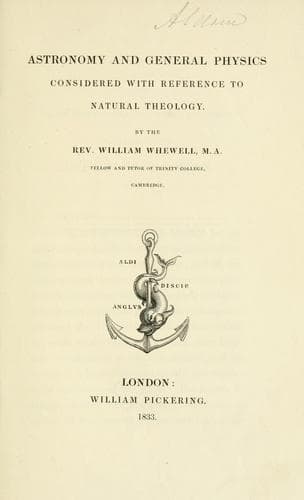
Astronomy and General Physics Considered with Reference to Natural TheologyWhewell, William
Religion
Astronomy and General Physics Considered with Reference to Natural Theology
Whewell, William
Astronomy; Cosmic physics; Natural theology
What can appear a more simple operation than standing and walking?
yet it is easy to see that without the aid of friction these simple
actions would scarcely be possible. Every one knows how difficult
and dangerous they are when performed on smooth ice. In such a
situation we cannot always succeed in standing: if the ice be very
smooth, it is by no means easy to walk, even when the surface is
perfectly level; and if it were ever so little inclined, no one
would make the attempt. Yet walking on the ice and on the ground
differ only in our experiencing more friction in the latter case.
We say _more_, for there is a considerable friction even in the
case of ice, as we see by the small distance which a stone slides
when thrown along the surface. It is this friction of the earth
which, at every step we take, prevents the foot from sliding back;
and thus allows us to push the body and the other foot forwards.
And when we come to violent bodily motions, to running, leaping,
pulling or pushing objects, it is easily seen how entirely we
depend upon the friction of the ground for our strength and force.
Every one knows how completely powerless we become in any of these
actions by the _foot slipping_.
In the same manner it is the friction of objects to which the
hand is applied, which enables us to hold them with any degree
of firmness. In some contests it was formerly the custom for the
combatants to rub their bodies with oil, that the adversary might
not be able to keep his grasp. If the pole of the boatman, the rope
of the sailor, were thus smooth and lubricated, how weak would be
the thrust and the pull! Yet this would only be the removal of
friction.
Our buildings are no less dependent on this force for their
stability. Some edifices are erected without the aid of cement; and
if the stones be large and well squared, such structures may be
highly substantial and durable; even when rude and slight, houses
so built answer the purposes of life. These are entirely upheld
by friction, and without that agent they would be thrown down by
the Zephyr, far more easily than if all the stones were lumps of
ice with a thawing surface. But even in cases where cement _binds_
the masonry, it does not take the duty of _holding_ it together.
In consequence of the existence of friction, there is no constant
tendency of the stones to separate; they are in a state of repose.
If this were not so, if every shock and every breeze required to be
counteracted by the cement, no composition exists which would long
sustain such a wear and tear. The cement excludes the corroding
elements, and helps to resist extraordinary violence; but it is
friction which gives the habitual state of rest.
Public-domain text, read in full here on John Shaqi.
Reviews
Reviews
No reviews yet
Be the first to share your thoughts on this work.
Elsewhere in the archive
Join the Discussion
Join the discussion
Sign in to leave a comment or review.
Sign InorCreate an account