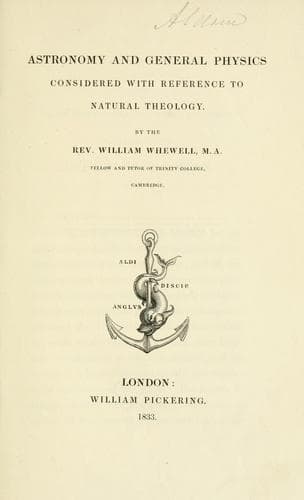
Astronomy and General Physics Considered with Reference to Natural TheologyWhewell, William
Religion
Astronomy and General Physics Considered with Reference to Natural Theology
Whewell, William
Astronomy; Cosmic physics; Natural theology
2. Now we have to observe concerning this agent, Friction, that
we have no ground for asserting it to be a necessary result of
other properties of matter, for instance, of their solidity and
coherency. Philosophers have not been able to deduce the laws of
friction from the other known properties of matter, nor even to
explain what we know experimentally of such laws, (which is not
much,) without introducing new hypotheses concerning the surfaces
of bodies, &c.--hypotheses which are not supplied us by any other
set of phenomena. So far as our knowledge goes, friction is a
separate property, and may be conceived to have been bestowed upon
matter for particular purposes. How well it answers the purpose
of fitting matter for the uses of the daily life of man, we have
already seen.
We may make suppositions as to the mode in which friction is
connected with the texture of bodies; but little can be gained for
philosophy, or for speculation of any kind, by such conjectures
respecting unknown connexions. If, on the other hand, we consider
this property of friction, and find that it prevails there, and
there only, where the general functions, analogies, and relations
of the universe require it, we shall probably receive a strong
impression that it was introduced into the system of the world _for
a purpose_.
3. It is very remarkable that this force, which is thus so
efficacious and discharges such important offices in all earthly
mechanism, disappears altogether when we turn to the mechanism
of the heavens. All motions on the earth soon stop;--a machine
which imitates the movements of the stars cannot go long without
winding up: but the stars themselves have gone on in their courses
for ages, with no diminution of their motions, and offer no
obvious prospect of any change. This is so palpable a fact, that
the first attempts of men to systematize their mechanical notions
were founded upon it. The ancients held that motions were to be
distinguished into _natural_ motions and _violent_,--the former
go on without diminution--the latter are soon extinguished;--the
motions of the stars are of the former kind;--those of a stone
thrown, and in short all terrestrial motions, of the latter. Modern
philosophers maintain that the laws of motion are the same for
celestial and terrestrial bodies;--that all motions are _natural_
according to the above description;--but that in terrestrial
motions, friction comes in and alters their character,--destroys
them so speedily that they appear to have existed only during an
effort. And that this is the case will not now be contested. Is
it not then somewhat remarkable that the same laws which produce
a state of permanent motion in the heavens, should, on the earth,
give rise to a condition in which rest is the rule and motion the
exception? The air, the waters, and the lighter portions of matter
are, no doubt, in a state of perpetual motion; over these friction
Public-domain text, read in full here on John Shaqi.
Reviews
Reviews
No reviews yet
Be the first to share your thoughts on this work.
Elsewhere in the archive
Join the Discussion
Join the discussion
Sign in to leave a comment or review.
Sign InorCreate an account