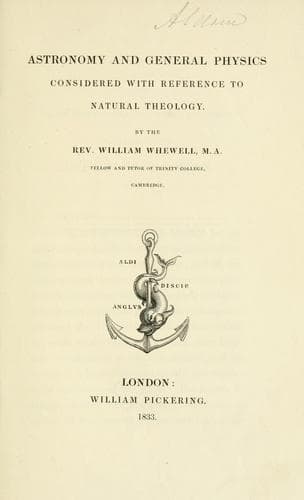
Astronomy and General Physics Considered with Reference to Natural TheologyWhewell, William
Religion
Astronomy and General Physics Considered with Reference to Natural Theology
Whewell, William
Astronomy; Cosmic physics; Natural theology
We are not to consider friction as a _small_ force, slightly
modifying the effects of other agencies. On the contrary its
amount is in most cases very great. When a body lies loose on the
ground, the friction is equal to one-third or one-half, or in some
cases the whole of its weight. But in cases of bodies supported by
oblique pressure, the amount is far more enormous. In the arch of a
bridge, the friction which is called into play between two of the
vaulting stones, may be equal to the whole weight of the bridge.
In such cases this conservative force is so great, that the common
theory, which neglects it, does not help us even to guess what
will take place. According to the theory, certain forms of arches
only will stand, but in practice almost any form will stand, and it
is not easy to construct a model of a bridge which will fall.
We may see the great force of friction in the _brake_, by which
a large weight running down a long inclined plane has its motion
moderated and stopt; in the windlass, where a few coils of the
rope round a cylinder sustain the stress and weight of a large
iron anchor; in the nail or screw which holds together large
beams; in the mode of raising large blocks of granite by an iron
rod driven into a hole in the stone. Probably no greater forces
are exercised in any processes in the arts than the force of
friction; and it is always employed to produce rest, stability,
moderate motion. Being always ready and never wearied, always at
hand and augmenting with the exigency, it regulates, controls,
subdues all motions;--counteracts all other agents;--and finally
gains the mastery over all other terrestrial agencies, however
violent, frequent, or long continued. The perpetual action of all
other terrestrial forces appears, on a large scale, only as so many
interruptions of the constant and stationary rule of friction.
The objects which every where surround us, the books or dishes
which stand on our tables, our tables and chairs themselves, the
loose clods and stones in the field, the heaviest masses produced
by nature or art, would be in a perpetual motion, quick or slow
according to the forces which acted on them, and to their size, if
it were not for the tranquillizing and steadying effects of the
agent we are considering. Without this, our apartments, if they
kept their shape, would exhibit to us articles of furniture, and of
all other kinds, sliding and creeping from side to side with every
push and every wind, like loose objects in a ship’s cabin, when she
is changing her course in a gale.
Here, then, we have a force, most extensive and incessant in its
operation, which is absolutely essential to the business of this
terrestrial world, according to any notion which we can form. The
more any one considers its effects, and the more he will find how
universally dependent he is upon it, in every action of his life;
resting or moving, dealing with objects of art or of nature, with
instruments of enjoyment or of action.
Public-domain text, read in full here on John Shaqi.
Reviews
Reviews
No reviews yet
Be the first to share your thoughts on this work.
Elsewhere in the archive
Join the Discussion
Join the discussion
Sign in to leave a comment or review.
Sign InorCreate an account