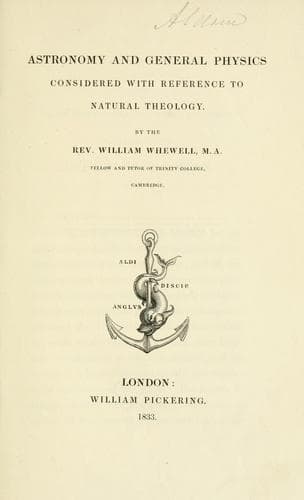
Astronomy and General Physics Considered with Reference to Natural TheologyWhewell, William
Religion
Astronomy and General Physics Considered with Reference to Natural Theology
Whewell, William
Astronomy; Cosmic physics; Natural theology
4. There is another view which may be taken of the forces which
operate on the earth to produce permanency or change. Some parts
of the terrestrial system are under the dominion of powers which
act energetically to prevent all motion, as the crystalline forces
by which the parts of rocks are bound together; other parts are
influenced by powers which produce a perpetual movement and change
in the matter of which they consist; thus plants and animals
are in a constant state of internal movement, by the agency of
the vital forces. In the former case rigid immutability, in the
latter perpetual developement, are the tendencies of the agencies
employed. Now in the case of objects affected by friction, we
have a kind of intermediate condition, between the constantly
fixed and the constantly moveable. Such objects can and do move;
but they move but for a short time if left to the laws of nature.
When at rest, they can easily be put in motion, but still not
with unlimited ease; a certain finite effort, different in
different cases, is requisite for their purpose. Now this immediate
condition, this capacity of receiving readily and alternately the
states of rest and motion, is absolutely requisite for the nature
of man, for the exertion of will, of contrivance, of foresight, as
well as for the comfort of life and the conditions of our material
existence. If all objects were fixed and immoveable, as if frozen
into one mass; or if they were susceptible of such motions only
as are found in the parts of vegetables, we attempt in vain to
conceive what would come of the business of the world. But besides
the state of a particle which cannot be moved, and of a particle
which cannot be stopped, we have the state of a particle moveable
but not moved; or moved, but moved only while we choose: and this
state is that about which the powers, the thoughts, and the wants
of man are mainly conversant.
Public-domain text, read in full here on John Shaqi.
Reviews
Reviews
No reviews yet
Be the first to share your thoughts on this work.
Elsewhere in the archive
Join the Discussion
Join the discussion
Sign in to leave a comment or review.
Sign InorCreate an account