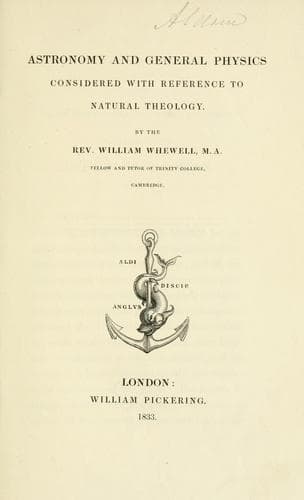
Astronomy and General Physics Considered with Reference to Natural TheologyWhewell, William
Religion
Astronomy and General Physics Considered with Reference to Natural Theology
Whewell, William
Astronomy; Cosmic physics; Natural theology
The conviction that the Divine attributes which we are taught by
the study of the material world, and those which we learn from
the contemplation of man as a responsible agent, belong to the
same Divine Being, will be forced upon us, if we consider the
manner in which all the parts of the universe, the corporeal and
intellectual, the animal and moral, are connected with each other.
In each of these provinces of creation we trace refined adaptations
and arrangements which lead us to the Creator and Director of so
skilful a system; but these provinces are so intermixed, these
different trains of contrivance so interwoven, that we cannot,
in our thoughts, separate the author of one part from the author
of another. The Creator of the Heavens and of the Earth, of the
inorganic and of the organic world, of animals and of man, of the
affections and the conscience, appears inevitably to be one and the
same God.
We will pursue this reflection a little more into detail.
1. The _Atmosphere_ is a mere mass of fluid floating on the
surface of the ball of the earth; it is one of the inert and
inorganic portions of the universe, and must be conceived to have
been formed by the same Power which formed the solid mass of the
earth and all other parts of the solar system. But how far is the
atmosphere from being inert in its effects on organic beings, and
unconnected with the world of life! By what wonderful adaptations
of its mechanical and chemical properties, and of the vital powers
of plants, to each other, are the developement and well-being
of plants and animals secured! The creator of the atmosphere
must have been also the creator of plants and animals: we cannot
for an instant believe the contrary. But the atmosphere is not
only subservient to the life of animals, and of man among the
rest; it is also the vehicle of voice; it answers the purpose of
intercourse; and, in the case of man, of rational intercourse.
We have seen how remarkably the air is fitted for this office;
the construction of the organs of articulation, by which they are
enabled to perform their part of the work, is, as is well known,
a most exquisite system of contrivances. But though living in an
atmosphere capable of transmitting articulate sound, and though
provided with organs fitted to articulate, man would never attain
to the use of language, if he were not also endowed with another
set of faculties. The powers of abstraction and generalization,
memory and reason, the tendencies which occasion the inflexions
and combinations of words, are all necessary to the formation and
use of language. Are not these parts of the same scheme of which
the bodily faculties by which we are able to speak are another
part? Has man his mental powers independently of the creator of
his bodily frame? To what purpose then, or by what cause was
the curious and complex machinery of the tongue, the glottis,
the larynx produced? These are useful for speech, and full of
Public-domain text, read in full here on John Shaqi.
Reviews
Reviews
No reviews yet
Be the first to share your thoughts on this work.
Elsewhere in the archive
Join the Discussion
Join the discussion
Sign in to leave a comment or review.
Sign InorCreate an account