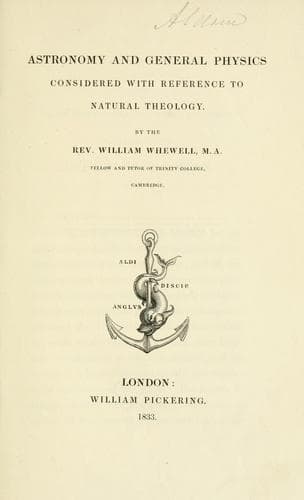
Astronomy and General Physics Considered with Reference to Natural TheologyWhewell, William
Religion
Astronomy and General Physics Considered with Reference to Natural Theology
Whewell, William
Astronomy; Cosmic physics; Natural theology
contrivances which suggest such a use as the end for which those
organs were constructed. But speech appears to have been no less
contemplated in the intellectual structure of man. The processes
of which we have spoken, generalization, abstraction, reasoning,
have a close dependence on the use of speech. These faculties are
presupposed in the formation of language, but they are developed
and perfected by the use of language. The mind of man then, with
all its intellectual endowments, is the work of the same artist by
whose hands his bodily frame was fashioned; as his bodily faculties
again are evidently constructed by the maker of those elements on
which their action depends. The creator of the atmosphere and of
the material universe is the creator of the human mind, and the
author of those wonderful powers of thinking, judging, inferring,
discovering, by we are able to reason concerning the world in which
we are placed; and which aid us in lifting our thoughts to the
source of our being himself.
2. _Light_, or the means by which light is propagated, is another
of the inorganic elements which forms a portion of the mere
material world. The luminiferous ether, if we adopt that theory,
or the fluid light of the theory of emission, must indubitably
pervade the remotest regions of the universe, and must be supposed
to exist, as soon as we suppose the material parts of the universe
to be in existence. The origin of light then must be at least as
far removed from us as the origin of the solar system. Yet how
closely connected are the properties of light with the structure
of our own bodies! The mechanism of the organs of vision and the
mechanism of light are, as we have seen, most curiously adapted to
each other. We must suppose, then, that the same power and skill
produced one and the other of these two sets of contrivances, which
so remarkably _fit into_ each other. The creator of light is the
author of our visual powers. But how small a portion does mere
visual perception constitute of the advantages which we derive from
vision! We possess ulterior faculties and capacities by which sight
becomes a source of happiness and good to man. The sense of beauty,
the love of art, the pleasure arising from the contemplation of
nature, are all dependent on the eye; and we can hardly doubt that
these faculties were bestowed on man to further the best interests
of his being. The sense of beauty both animates and refines his
domestic tendencies; the love of art is a powerful instrument for
raising him above the mere cravings and satisfactions of his animal
nature; the expansion of mind which rises in us at the sight of the
starry sky, the cloud-capt mountain, the boundless ocean, seems
intended to direct our thoughts by an impressive though indefinite
feeling, to the Infinite Author of All. But if these faculties be
thus part of the scheme of man’s inner being, given him by a good
and wise creator, can we suppose that this creator was any other
Public-domain text, read in full here on John Shaqi.
Reviews
Reviews
No reviews yet
Be the first to share your thoughts on this work.
Elsewhere in the archive
Join the Discussion
Join the discussion
Sign in to leave a comment or review.
Sign InorCreate an account