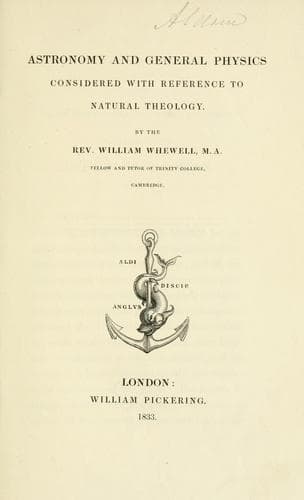
Astronomy and General Physics Considered with Reference to Natural TheologyWhewell, William
Religion
Astronomy and General Physics Considered with Reference to Natural Theology
Whewell, William
Astronomy; Cosmic physics; Natural theology
It is not necessary here to follow out and classify these emotions
and affections; or to examine how they are combined and connected
with our other motives of action, mutually giving and receiving
strength and direction. The desire of esteem, of power, of
knowledge, of society, the love of kindred, of friends, of our
country, are manifestly among the main forces by which man is urged
to act and to abstain. And as these parts of the constitution of
man are clearly intended, as we conceive, to impel him in his
appointed path; so we conceive that they are no less clearly the
work of the same great Artificer who created the heart, the eye,
the hand, the tongue, and that elemental world in which, by means
of these instruments, man pursues the objects of his appetites,
desires, and affections.
5. But if the Creator of the world be also the author of our
intellectual powers, of our feeling for the beautiful and the
sublime, of our social tendencies, and of our natural desires and
affections, we shall find it impossible not to ascribe also to Him
the higher directive attributes of our nature, the conscience and
the religious feeling, the reference of our actions to the rule of
duty and to the will of God.
It would not suit the plan of the present treatise to enter into
any detailed analysis of the connexion of these various portions
of our moral constitution. But we may observe that the existence
and universality of the conception of duty and right cannot be
doubted, however men may differ as to its original or derivative
nature. All men are perpetually led to form judgments concerning
actions, and emotions which lead to action, as right or wrong;
as what they _ought_ or _ought not_ to do or feel. There is a
faculty which approves and disapproves, acquits or condemns the
workings of our other faculties. Now, what shall we say of such
a judiciary principle, thus introduced among our motives to
action? Shall we conceive that while the other springs of action
are balanced against each other by our Creator, this, the most
pervading and universal regulator, was no part of the original
scheme? That--while the love of animal pleasures, of power, of
fame, the regard for friends, the pleasure of bestowing pleasure,
were infused into man as influences by which his course of life
was to be carried on, and his capacities and powers developed and
exercised;--this reverence for a moral law, this acknowledgment
of the obligation of duty,--a feeling which is every where found,
and which may become a powerful, a predominating motive of
action,--was given for no purpose, and belongs not to the design?
Such an opinion would be much as if we should acknowledge the
skill and contrivance manifested in the other parts of a ship, but
should refuse to recognize the rudder as exhibiting any evidence
of a purpose. Without the reverence which the opinion of right
inspires, and the scourge of general disapprobation inflicted on
Public-domain text, read in full here on John Shaqi.
Reviews
Reviews
No reviews yet
Be the first to share your thoughts on this work.
Elsewhere in the archive
Join the Discussion
Join the discussion
Sign in to leave a comment or review.
Sign InorCreate an account