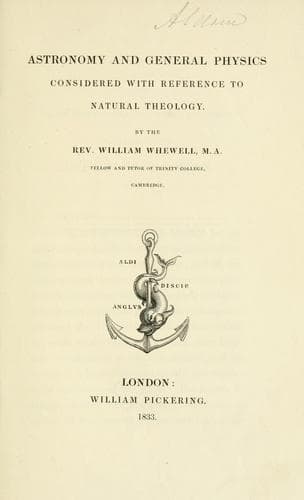
Astronomy and General Physics Considered with Reference to Natural TheologyWhewell, William
Religion
Astronomy and General Physics Considered with Reference to Natural Theology
Whewell, William
Astronomy; Cosmic physics; Natural theology
that which is accounted wicked, society could scarcely go on; and
certainly the feelings and thoughts and characters of men could
not be what they are. Those impulses of nature which involve no
acknowledgment of responsibility, and the play and struggle of
interfering wishes, might preserve the species in some shape of
existence, as we see in the case of brutes. But a person must be
strangely constituted, who, living amid the respect for law, the
admiration for what is good, the order and virtues and graces of
civilized nations, (all which have their origin in some degree in
the feeling of responsibility) can maintain that all these are
casual and extraneous circumstances, no way contemplated in the
formation of man; and that a condition in which there should be
obligation in law, no merit in self-restraint, no beauty in virtue,
is equally suited to the powers and the nature of man, and was
equally contemplated when those powers were given him.
If this supposition be too extravagant to be admitted, as
it appears to be, it remains then that man, intended, as we
have already seen from his structure and properties, to be
a discoursing, social being, acting under the influence of
affections, desires, and purposes, was also intended to act under
the influence of a sense of duty; and that the acknowledgment of
the obligation of a moral law is as much part of his nature, as
hunger or thirst, maternal love or the desire of power; that,
therefore, in conceiving man as the work of a Creator, we must
imagine his powers and character given him with an intention on
the Creator’s part that this sense of duty should occupy its place
in his constitution as an active and thinking being: and that this
directive and judiciary principle is a part of the work of the same
Author who made the elements to minister to the material functions,
and the arrangements of the world to occupy the individual and
social affections of his living creatures.
This principle of conscience, it may further be observed, does not
stand upon the same level as the other impulses of our constitution
by which we are prompted or restrained. By its very nature and
essence, it possesses a supremacy over all others. “Your obligation
to obey this law is its being the law of your nature. That your
conscience approves of and attests such a course of action is
itself alone an obligation. Conscience does not only offer itself
to show us the way we should walk in, but it likewise carries its
own authority with it, that it is our natural guide: the guide
assigned us by the author of our nature.”[26] That we ought to do
an action, is of itself a sufficient and ultimate answer to the
questions, _why_ we should do it?--how we are _obliged_ to do it?
The conviction of duty implies the soundest reason, the strongest
obligation, of which our nature is susceptible.
Public-domain text, read in full here on John Shaqi.
Reviews
Reviews
No reviews yet
Be the first to share your thoughts on this work.
Elsewhere in the archive
Join the Discussion
Join the discussion
Sign in to leave a comment or review.
Sign InorCreate an account