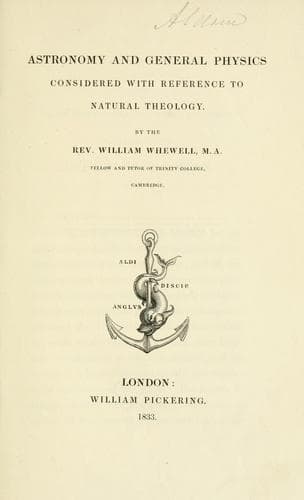
Astronomy and General Physics Considered with Reference to Natural TheologyWhewell, William
Religion
Astronomy and General Physics Considered with Reference to Natural Theology
Whewell, William
Astronomy; Cosmic physics; Natural theology
1. The aspect of the world, even without any of the peculiar lights
which science throws upon it, is fitted to give us an idea of the
greatness of the power by which it is directed and governed, far
exceeding any notions of power and greatness which are suggested by
any other contemplation. The number of human beings who surround
us--the various conditions requisite for their life, nutrition,
well-being, all fulfilled;--the way in which these conditions are
modified, as we pass in thought to other countries, by climate,
temperament, habit;--the vast amount of the human population of the
globe thus made up;--yet man himself but one among almost endless
tribes of animals;--the forest, the field, the desert, the air,
the ocean, all teeming with creatures whose bodily wants are as
carefully provided for as his;--the sun, the clouds, the winds,
all attending, as it were, on these organized beings;--a host of
beneficent energies, unwearied by time and succession, pervading
every corner of the earth;--this spectacle cannot but give the
contemplator a lofty and magnificent conception of the Author of
so vast a work, of the Ruler of so wide and rich an empire, of the
Provider for so many and varied wants, the Director and Adjuster of
such complex and jarring interests.
But when we take a more exact view of this spectacle, and aid our
vision by the discoveries which have been made of the structure and
extent of the universe, the impression is incalculably increased.
The number and variety of animals, the exquisite skill displayed
in their structure, the comprehensive and profound relations by
which they are connected, far exceed any thing which we could in
any degree have imagined. But the view of the universe expands also
on another side. The earth, the globular body thus covered with
life, is not the only globe in the universe. There are, circling
about our own sun, six others, so far as we can judge, perfectly
analogous in their nature: besides our moon and other bodies
analogous to it. No one can resist the temptation to conjecture,
that these globes, some of them much larger than our own, are
not dead and barren;--that they are, like ours, occupied with
organization, life, intelligence. To conjecture is all that we can
do, yet even by the perception of such a possibility, our view of
the kingdom of nature is enlarged and elevated. The outermost of
the planetary globes of which we have spoken is so far from the
sun, that the central luminary must appear to the inhabitants of
that planet, if any there are, no larger than Venus does to us; and
the length of their year will be eighty-two of ours.
Public-domain text, read in full here on John Shaqi.
Reviews
Reviews
No reviews yet
Be the first to share your thoughts on this work.
Elsewhere in the archive
Join the Discussion
Join the discussion
Sign in to leave a comment or review.
Sign InorCreate an account