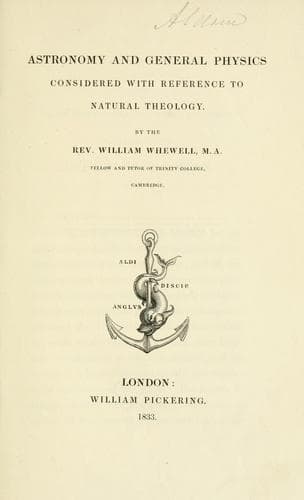
Astronomy and General Physics Considered with Reference to Natural TheologyWhewell, William
Religion
Astronomy and General Physics Considered with Reference to Natural Theology
Whewell, William
Astronomy; Cosmic physics; Natural theology
But astronomy carries us still onwards. It teaches us that, with
the exception of the planets already mentioned, the stars which
we see have no immediate relation to our system. The obvious
supposition is that they are of the nature and order of our
sun: the minuteness of their apparent magnitude agrees, on this
supposition, with the enormous and almost inconceivable distance
which, from all the measurements of astronomers, we are led to
attribute to them. If then these are suns, they may, like our sun,
have planets revolving round them; and these may, like our planet,
be the seats of vegetable and animal and rational life:--we may
thus have in the universe worlds, no one knows how many, no one can
guess how varied:--but however many, however varied, they are still
but so many provinces in the same empire, subject to common rules,
governed by a common power.
But the stars which we see with the naked eye are but a very small
portion of those which the telescope unveils to us. The most
imperfect telescope will discover some that are invisible without
it; the very best instrument perhaps does not show us the most
remote. The number which crowds some parts of the heavens is truly
marvellous. Dr. Herschel calculated that a portion of the milky
way, about ten degrees long and two and a half broad, contained two
hundred and fifty-eight thousand. In a sky so occupied, the moon
would eclipse two thousand of such stars at once.
We learn too from the telescope that even in this province the
variety of nature is not exhausted. Not only do the stars differ in
colour and appearance, but some of them grow periodically fainter
and brighter, as if they were dark on one side, and revolved on
their axes. In other cases two stars appear close to each other,
and in some of these cases it has been clearly established,
that the two have a motion of revolution about each other; thus
exhibiting an arrangement before unguessed, and giving rise,
possibly, to new conditions of worlds. In other instances again,
the telescope shows, not luminous points, but extended masses of
dilute light, like bright clouds, hence called _nebulæ_. Some
have supposed (as we have noticed in the last book) that such
nebulæ by further condensation might become suns; but for such
opinions we have nothing but conjecture. Some stars again have
undergone permanent changes, or have absolutely disappeared, as the
celebrated star of 1572, in the constellation Cassiopea.
Public-domain text, read in full here on John Shaqi.
Reviews
Reviews
No reviews yet
Be the first to share your thoughts on this work.
Elsewhere in the archive
Join the Discussion
Join the discussion
Sign in to leave a comment or review.
Sign InorCreate an account