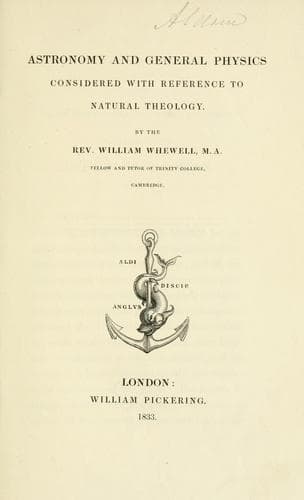
Astronomy and General Physics Considered with Reference to Natural TheologyWhewell, William
Religion
Astronomy and General Physics Considered with Reference to Natural Theology
Whewell, William
Astronomy; Cosmic physics; Natural theology
4. The above statements are vast in amount, and almost oppressive
to our faculties. They belong to the measurement of the powers
which are exerted in the universe, and of the spaces through which
their efficacy reaches (for the most distant bodies are probably
connected both by gravity and light.) But these estimates cannot be
said so much to give us any notion of the powers of the Deity, as
to correct the errors we should fall into by supposing his powers
at all to resemble ours:--by supposing that numbers, and spaces,
and forces, and combinations, which would overwhelm us, are any
obstacle to the arrangements which his plan requires. We can easily
understand that to an intelligence surpassing ours in degree only,
that may be easy which is impossible to us. The child who cannot
count beyond four, the savage who has no name for any number above
five, cannot comprehend the possibility of dealing with thousands
and millions: yet a little additional developement of the intellect
makes such numbers manageable and conceivable. The difficulty
which appears to reside in numbers and magnitudes and stages of
subordination, is one produced by judging from ourselves--by
measuring with our own sounding line; when that reaches no bottom,
the ocean appears unfathomable. Yet in fact, how is a hundred
millions of miles a _great_ distance? how is a hundred millions
of times a _great_ ratio? Not in itself: this _greatness_ is no
quality of the numbers which can be proved like their mathematical
properties; on the contrary, all that absolutely belongs to number,
space, and ratio, must, we know demonstrably, be equally true of
the largest and the smallest. It is clear that the _greatness_ of
these expressions of measure has reference to _our_ faculties only.
Our astonishment and embarrassment take for granted the limits
of our own nature. We have a tendency to treat a difference of
degree and of addition, as if it were a difference of kind and of
transformation. The existence of the attributes, design, power,
goodness, is a matter depending on obvious grounds: about these
qualities there can be no mistake: if we can know any thing, we
can know these attributes when we see them. But the extent, the
limits of such attributes must be determined by their effects; our
knowledge of their limits by what we see of the effects. Nor is any
extent, any amount of power and goodness improbable beforehand: we
know that these must be great, we cannot tell how great. We should
not expect beforehand to find them bounded; and therefore when the
boundless prospect opens before us, we may be bewildered, but we
have no reason to be shaken in our conviction of the reality of
the cause from which their effects proceed: we may feel ourselves
incapable of following the train of thought, and may stop, but we
have no rational motive for quitting the point which we have thus
attained in tracing the Divine Perfections.
Public-domain text, read in full here on John Shaqi.
Reviews
Reviews
No reviews yet
Be the first to share your thoughts on this work.
Elsewhere in the archive
Join the Discussion
Join the discussion
Sign in to leave a comment or review.
Sign InorCreate an account