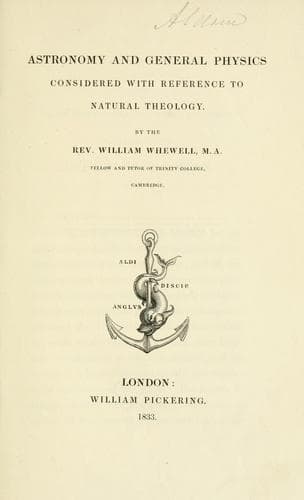
Astronomy and General Physics Considered with Reference to Natural TheologyWhewell, William
Religion
Astronomy and General Physics Considered with Reference to Natural Theology
Whewell, William
Astronomy; Cosmic physics; Natural theology
On such a terrestrial globe the highest mountains would be
about an eightieth of an inch high, and consequently only just
distinguishable. We may imagine therefore how imperceptible would
be the largest animals. The whole organized covering of such a
globe would be quite undiscoverable by the eye, except perhaps by
colour, like the bloom on a plum.
In order to restore this earth and its inhabitants to their true
dimensions, we must magnify them forty millions of times; and to
preserve the proportions, we must increase equally the distances
of the sun and of the stars from us. They seem thus to pass off
into infinity; yet each of them thus removed, has its system of
mechanical and perhaps of organic processes going on upon its
surface.
But the arrangements of organic life which we can see with the
naked eye are few, compared with those which the microscope
detects. We know that we may magnify objects thousands of times,
and still discover fresh complexities of structure; if we suppose,
therefore, that we increase every particle of matter in our
universe in such a proportion, in length, breadth, and thickness,
we may conceive that we tend thus to bring before our apprehension
a true estimate of the quantity of organized adaptations which are
ready to testify the extent of the Creator’s power.
3. The other numerical quantities which we have to consider in
the phenomena of the universe are on as gigantic a scale as the
distances and sizes. By the rotation of the earth on its axis, the
parts of the equator move at the rate of a thousand miles an hour,
and the portions of the earth’s surface which are in our latitude,
at about six hundred. The former velocity is nearly that with
which a cannon ball is discharged from the mouth of a gun; but,
large as it is, it is inconsiderable compared with the velocity
of the earth in its orbit about the sun. This latter velocity is
sixty-five times the former. By the rotatory motion of the earth,
a point of its surface is carried sometimes forwards and sometimes
backwards with regard to the annual progression; but in consequence
of the great predominance of the latter velocity in amount, the
former scarcely affects it either way. And even the latter velocity
is inconsiderable compared with that of light; which comparison,
however, we shall not make; since, according to the theory we have
considered as most probable, the motion of light is not a transfer
of matter but of motion from one part of space to another.
The extent of the scale of density of different substances has
already been mentioned; gold is twenty times as heavy as water; air
is eight hundred and thirty times lighter, steam eight thousand
times lighter than water; the luminiferous ether is incomparably
rarer than steam: and this is true of the matter of light, whether
we adopt the undulatory theory or any other.
Public-domain text, read in full here on John Shaqi.
Reviews
Reviews
No reviews yet
Be the first to share your thoughts on this work.
Elsewhere in the archive
Join the Discussion
Join the discussion
Sign in to leave a comment or review.
Sign InorCreate an account