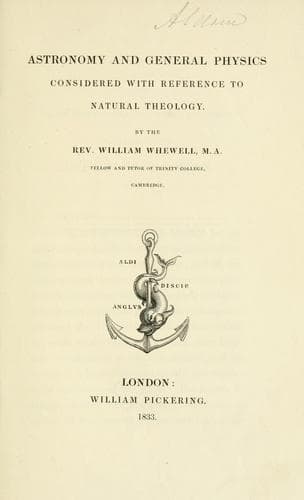
Astronomy and General Physics Considered with Reference to Natural TheologyWhewell, William
Religion
Astronomy and General Physics Considered with Reference to Natural Theology
Whewell, William
Astronomy; Cosmic physics; Natural theology
1. We may, in the first place, repeat the observation made in
the last chapter, on the confusion which sometimes arises in our
minds, and makes us consider the number of the objects of the
Divine care as a difficulty in the way of its exercise. If we
can conceive this care employed on a million of persons, on the
population of a kingdom, of a city, of a street, there is no real
difficulty in supposing it extended to every planet in the solar
system, admitting each to be peopled as ours is; nor to every
part of the universe, supposing each star the centre of such a
system. _Numbers_ are nothing in themselves; and when we reject the
known, but unessential limits of our own faculties, it is quite as
allowable to suppose a million millions of earths, as one, to be
under the moral government of God.
2. In the next place we may remark, not only that no reason can be
assigned why the Divine care should not extend to a much greater
number of individuals than we at first imagine, but that in fact
we know that it _does_ so extend. It has been well observed, that
about the same time when the invention of the telescope showed us
that there might be myriads of other worlds claiming the Creator’s
care; the invention of the microscope proved to us that there were
in our own world myriads of creatures, before unknown, which this
care was preserving. While one discovery seemed to remove the
Divine Providence further from us, the other gave us most striking
examples that it was far more active in our neighbourhood than we
had supposed: while the first extended the boundaries of God’s
known kingdom, the second made its known administration more minute
and careful. It appeared that in the leaf and in the bud, in solids
and in fluids, animals existed hitherto unsuspected; the apparently
dead masses and blank spaces of the world were found to swarm with
life. And yet, of the animals thus revealed, all, though unknown to
us before, had never been forgotten by Providence. Their structure,
their vessels and limbs, their adaptation to their situation, their
food and habitations, were regulated in as beautiful and complete
a manner as those of the largest and apparently most favoured
animals. The smallest insects are as exactly finished, often as
gaily ornamented, as the most graceful beasts or the birds of
brightest plumage. And when we seem to go out of the domain of the
complex animal structure with which we are familiar, and come to
animals of apparently more scanty faculties, and less developed
powers of enjoyment and action, we still find that their faculties
and their senses are in exact harmony with their situation and
circumstances; that the wants which they have are provided for, and
the powers which they possess called into activity. So that Müller,
the patient and accurate observer of the smallest and most obscure
microscopical animalcula, declares that all classes alike, those
which have manifest organs, and those which have not, offer a vast
Public-domain text, read in full here on John Shaqi.
Reviews
Reviews
No reviews yet
Be the first to share your thoughts on this work.
Elsewhere in the archive
Join the Discussion
Join the discussion
Sign in to leave a comment or review.
Sign InorCreate an account