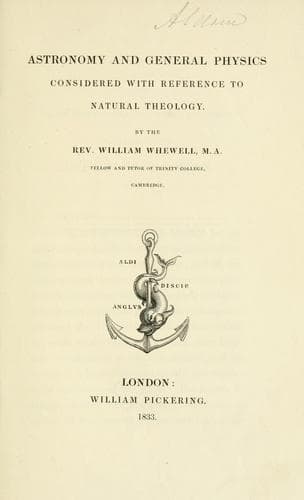
Astronomy and General Physics Considered with Reference to Natural TheologyWhewell, William
Religion
Astronomy and General Physics Considered with Reference to Natural Theology
Whewell, William
Astronomy; Cosmic physics; Natural theology
That there must be an order and a system to which such regulative
principles belong, the whole analogy of creation compels us to
believe. It would be strange indeed, if, while the mechanical
world, the system of inert matter, is so arranged that we
cannot contemplate its order without an elevated intellectual
pleasure;--while organized life has no faculties without their
proper scope, no tendencies without their appointed object;--the
rational faculties and moral tendencies of man should belong to no
systematic order, should operate with no corresponding purpose:
that, while the perception of sweet and bitter has its acknowledged
and unmistakeable uses, the universal perception of right and
wrong, the unconquerable belief of the merit of certain feelings
and actions, the craving alike after moral advancement and after
the means of attaining it, should exist only to delude, perplex,
and disappoint man. No one, with his contemplations calmed and
filled and harmonized by the view of the known constitution of
the universe, its machinery “wheeling unshaken” in the farthest
skies and in the darkest cavern, its vital spirit breathing alike
effectively in the veins of the philosopher and the worm;--no one,
under the influence of such a train of contemplations, can possibly
admit into his mind a persuasion which makes the moral part of
our nature a collection of inconsistent and futile impressions,
of idle dreams and warring opinions, each having the same claims
to our acceptance. Wide as is the distance between the material
and the moral world; shadowy as all reasonings necessarily are
which attempt to carry the inferences of one into the other;
elevated above the region of matter as all the principles and
grounds of truth must be, which belong to our responsibilities
and hopes; still the astronomical and natural philosopher can
hardly fail to draw from their studies an imperturbable conviction
that our moral nature cannot correspond to those representations
according to which it has no law, coherency, or object. The mere
natural reasoner may, or must stop far short of all that it is
his highest interest to know, his first duty to pursue; but even
he, if he take any elevated and comprehensive views of his own
subject, must escape from the opinions, as unphilosophical as they
are comfortless, which would expel from our view of the world
all reference to duty and moral good, all reliance on the most
universal grounds of trust and hope.
Men’s belief of their duty, and of the reasons for practising it,
connected as it is with the conviction of a personal relation to
their Maker, and of His power of superintendence and reward, is as
manifest a fact in the moral, as any that can be pointed out is
in the natural world. By mere analogy which has been intimated,
therefore, we cannot but conceive that this fact belongs in some
manner or other to the order of the moral world, and of its
government.
Public-domain text, read in full here on John Shaqi.
Reviews
Reviews
No reviews yet
Be the first to share your thoughts on this work.
Elsewhere in the archive
Join the Discussion
Join the discussion
Sign in to leave a comment or review.
Sign InorCreate an account