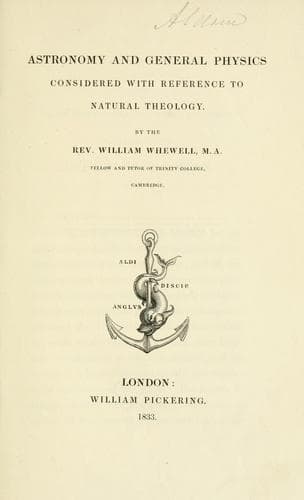
Astronomy and General Physics Considered with Reference to Natural TheologyWhewell, William
Religion
Astronomy and General Physics Considered with Reference to Natural Theology
Whewell, William
Astronomy; Cosmic physics; Natural theology
We shall begin with the latter class of adaptations, because in
treating of these the facts are more familiar and tangible, and the
reasonings less abstract and technical, than in the other division
of the subject. Moreover, in this case men have no difficulty
in recognizing as desirable the end which is answered by such
adaptations, and they therefore the more readily consider it _as
an end_. The nourishment, the enjoyment, the diffusion of living
things, are willingly acknowledged to be a suitable object for
contrivance; the simplicity, the permanence, of an inert mechanical
combination might not so readily be allowed to be a manifestly
worthy aim of a Creating Wisdom. The former branch of our argument
may therefore be best suited to introduce to us the Deity as the
institutor of Laws of Nature, though the latter may afterwards give
us a wider view and a clearer insight into one province of his
legislation.
BOOK I.
TERRESTRIAL ADAPTATIONS.
We proceed in this book to point out relations which subsist
between the laws of the inorganic world, that is, the general facts
of astronomy and meteorology; and the laws which prevail in the
organic world, the properties of plants and animals.
With regard to the first kind of laws, they are in the highest
degree various and unlike each other. The intensity and activity
of natural influences follow in different cases the most different
rules. In some instances they are _periodical_, increasing and
diminishing alternately, in a perpetual succession of equal
intervals of time. This is the case with the heat at the earth’s
surface, which has a period of a year; with the light, which has a
period of a day. Other qualities are _constant_, thus the force of
gravity at the same place is always the same. In some cases, a very
simple cause produces very complicated effects; thus the globular
form of the earth, and the inclination of its axis during its
annual motion, give rise to all the variety of climates. In other
cases a very complex and variable system of causes produces effects
comparatively steady and uniform; thus solar and terrestrial heat,
air, moisture, and probably many other apparently conflicting
agents, join to produce our weather, which never deviates very far
from a certain average standard.
Public-domain text, read in full here on John Shaqi.
Reviews
Reviews
No reviews yet
Be the first to share your thoughts on this work.
Join the Discussion
Join the discussion
Sign in to leave a comment or review.
Sign InorCreate an account