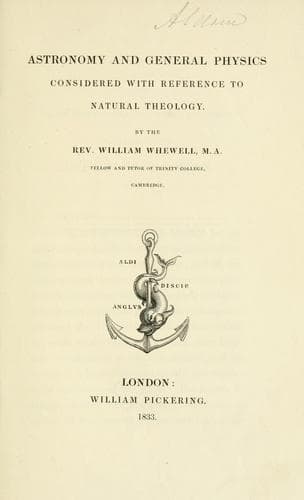
Astronomy and General Physics Considered with Reference to Natural TheologyWhewell, William
Religion
Astronomy and General Physics Considered with Reference to Natural Theology
Whewell, William
Astronomy; Cosmic physics; Natural theology
In the Dialogues on Mechanics, there occur those observations
concerning the use of the air-bladder in fishes, and concerning the
adaptation of the size of animals to the strength of the materials
of which they are framed, which have often since been adopted by
writers on the wisdom of Providence. The last of the dialogues on
the system of the world is closed by a religious reflection, put
in the mouth of the interlocutor who usually expresses Galileo’s
own opinions. “While it is permitted us to speculate concerning the
constitution of the world, we are also taught (perhaps in order
that the activity of the human mind may not pause or languish) that
our powers do not enable us to comprehend the works of His hands.
May success therefore attend this intellectual exercise, thus
permitted and appointed for us; by which we recognize and admire
the greatness of God the more, in proportion as we find ourselves
the less able to penetrate the profound abysses of his wisdom.”
And that this train of thought was habitual to the philosopher we
have abundant evidence in many other parts of his writings. He had
already said in the same dialogue, “Nature (or God, as he elsewhere
speaks) employs means in an admirable and inconceivable manner;
admirable, that is, and inconceivable to us, but not to her, who
brings about with consummate facility and simplicity things which
affect our intellect with infinite astonishment. That which is to
us most difficult to understand is to her most easy to execute.”
The establishment of the Copernican and Newtonian views of the
motions of the solar system and their causes, were probably the
occasions on which religious but unphilosophical men entertained
the strongest apprehensions that the belief in the government of
God may be weakened when we thus “thrust some mechanic cause into
his place.” It is therefore fortunate that we can show, not only
that this ought not to occur, from the reason of the thing, but
also that in fact the persons who are the leading characters in the
progress of these opinions were men of clear and fervent piety.
Public-domain text, read in full here on John Shaqi.
Reviews
Reviews
No reviews yet
Be the first to share your thoughts on this work.
Elsewhere in the archive
Join the Discussion
Join the discussion
Sign in to leave a comment or review.
Sign InorCreate an account