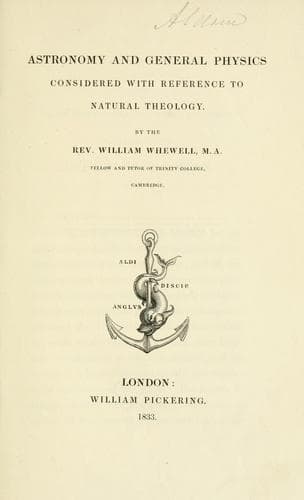
Astronomy and General Physics Considered with Reference to Natural TheologyWhewell, William
Religion
Astronomy and General Physics Considered with Reference to Natural Theology
Whewell, William
Astronomy; Cosmic physics; Natural theology
We shall not dwell much on the first of the above mentioned great
names, Galileo; for his scientific merit consisted rather in
adopting the sound philosophy of others, as in the case of the
Copernican system, and in combating prevalent errors, as in the
case of the Aristotelian doctrines concerning motion, than in
any marked and prominent discovery of new principles. Moreover
the mechanical laws which he had a share in bringing to light,
depending as they did, rather on detached experiments and transient
facts, than on observation of the general course of the universe,
could not so clearly suggest any reflection on the government of
the world at that period, as they did afterwards when Newton showed
their bearing on the cosmical system. Yet Galileo, as a man of
philosophical and inventive mind, who produced a great effect on
the progress of physical knowledge, is a person whose opinions must
naturally interest us, engaged in our present course of reasoning.
There is in his writings little which bears upon religious views,
as there is in the nature of his works little to lead him to such
subjects. Yet strong expressions of piety are not wanting, both
in his letters, and in his published treatises. The persecution
which he underwent, on account of his writings in favour of the
Copernican system, was grounded, not on his opposition to the
general truths of natural religion, which is our main concern at
present, nor even on any supposed rejection of any articles of
Christian faith, but on the alleged discrepancy between his adopted
astronomical views and the declarations of scripture. Some of his
remarks may interest the reader.
In his third dialogue on the Copernican system he has occasion
to speak of the opinion which holds all parts of the world to be
framed for man’s use alone: and to this he says, “I would that we
should not so shorten the arm of God in the government of human
affairs; but that we should rest in this, that we are certain
that God and nature are so occupied in the government of human
affairs, that they could not more attend to us if they were charged
with the care of the human race alone.” In the same spirit, when
some objected to the asserted smallness of the Medicean stars, or
satellites of Jupiter, and urged this as a reason why they were
unworthy the regard of philosophers, he replied that they are the
works of God’s power, the objects of His care, and therefore may
well be considered as sublime subjects for man’s study.
Public-domain text, read in full here on John Shaqi.
Reviews
Reviews
No reviews yet
Be the first to share your thoughts on this work.
Elsewhere in the archive
Join the Discussion
Join the discussion
Sign in to leave a comment or review.
Sign InorCreate an account