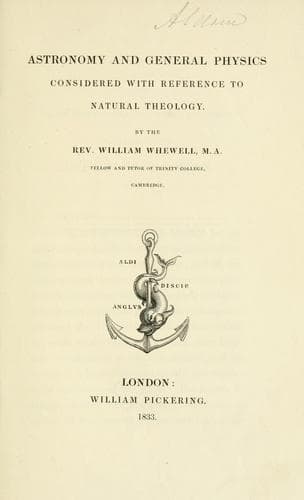
Astronomy and General Physics Considered with Reference to Natural TheologyWhewell, William
Religion
Astronomy and General Physics Considered with Reference to Natural Theology
Whewell, William
Astronomy; Cosmic physics; Natural theology
We have pointed out a great number of instances where the mode in
which the arrangements of nature produce their effect, suggests,
as we conceive, the belief that this effect is to be considered as
the _end_ and _purpose_ of these arrangements. The impression which
thus arises, of design and intention exercised in the formation of
the world, or of the reality of _Final Causes_, operates on men’s
minds so generally, and increases so constantly on every additional
examination of the phenomena of the universe, that we cannot but
suppose such a belief to have a deep and stable foundation. And we
conceive that in several of the comparatively few cases in which
such a belief has been rejected, the averseness to it has arisen
from the influence of some of the causes mentioned in the last
chapter; the exclusive pursuit, namely, of particular trains and
modes of reasoning, till the mind becomes less capable of forming
the conceptions and making the exertions which are requisite for
the apprehension of truths not included among its usual subjects of
thought.
1. This seems to be the case with those who maintain that purpose
and design cannot be _inferred_ or _deduced_ from the arrangements
which we see around us by any process of reasoning. We can reason
from effects to causes, say such writers, only in cases where we
know something of the nature of the cause. We can infer from the
works of men, the existence of design and purpose, because we
know, from past observation, what kind of works human design and
purpose can produce. But the universe, considered as the work of
God, cannot be compared with any corresponding work, or judged
of by any analogy with known examples. How then can we, in this
case, they ask, infer design and purpose in the artist of the
universe? On what principles, on what axioms, can we proceed, which
shall include this necessarily singular instance, and thus give
legitimacy and validity to our reasonings?
What has already been said on the subject of the two different
processes by which we obtain principles, and by which we reason
from them, will suggest the reply to these questions. When we
collect design and purpose from the arrangements of the universe,
we do not arrive at our conclusion by a train of deductive
reasoning, but by the conviction which such combinations as we
perceive immediately and directly impress upon the mind. “Design
must have had a designer.” But such a principle can be of no avail
to one whom the contemplation or the description of the world does
not impress with the perception of design. It is not, therefore, at
the end, but at the beginning of our syllogisms, not among remote
conclusions, but among original principles, that we must place the
truth, that such arrangements, manifestations, and proceedings
as we behold about us imply a Being endowed with consciousness,
design, and will, from whom they proceed.
Public-domain text, read in full here on John Shaqi.
Reviews
Reviews
No reviews yet
Be the first to share your thoughts on this work.
Elsewhere in the archive
Join the Discussion
Join the discussion
Sign in to leave a comment or review.
Sign InorCreate an account