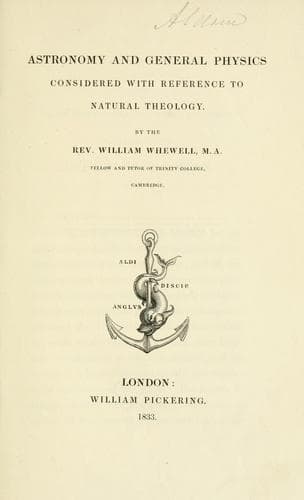
Astronomy and General Physics Considered with Reference to Natural TheologyWhewell, William
Religion
Astronomy and General Physics Considered with Reference to Natural Theology
Whewell, William
Astronomy; Cosmic physics; Natural theology
them nearer, though it must ever remain indefinitely beyond their
reach.
It scarcely needs, perhaps, to be noticed, that what we here
represent as the possible source of error is, not the perfection
of the mathematical habits of the mind, but the deficiency of the
habit of apprehending truth of other kinds;--not a clear insight
into the mathematical consequences of principles, but a want of
a clear view of the nature and foundation of principles;--not
the talent for generalizing geometrical or mechanical relations,
but the tendency to erect such relations into ultimate truths
and efficient causes. The most consummate mathematical skill may
accompany and be auxiliary to the most earnest piety, as it often
has been. And an entire command of the conceptions and processes
of mathematics is not only consistent with, but is the necessary
condition and principal instrument of every important step in the
discovery of physical principles. Newton was eminent above the
philosophers of his time, in no one talent so much as in the power
of mathematical deduction. When he had caught sight of the law of
universal gravitation, he traced it to its consequences with a
rapidity, a dexterity, a beauty of mathematical reasoning which no
other person could approach; so that on this account, if there had
been no other, the establishment of the general law was possible to
him alone. He still stands at the head of mathematicians as well
as of philosophical discoverers. But it never appeared to him,
as it may have appeared to some mathematicians who have employed
themselves on his discoveries, that the general law was an ultimate
and sufficient principle: that the point to which he had hung his
chain of deduction was the highest point in the universe. Lagrange,
a modern mathematician of transcendent genius, was in the habit
of saying, in his aspirations after future fame, that Newton was
fortunate in having had the system of the world for his problem,
since its theory could be discovered once only. But Newton himself
appears to have had no such persuasion that the problem he had
solved was unique and final: he laboured to reduce gravity to some
higher law, and the forces of other physical operations to an
analogy with those of gravity, and declared that all these were
but steps in our advance towards a first cause. Between us and
this first cause, the source of the universe and of its laws, we
cannot doubt that there intervene many successive steps of possible
discovery and generalization, not less wide and striking than the
discovery of universal gravitation: but it is still more certain
that no extent or success of physical investigation can carry us to
any point which is not at an immeasurable distance from an adequate
knowledge of Him.
CHAPTER VII.
_On Final Causes._
Public-domain text, read in full here on John Shaqi.
Reviews
Reviews
No reviews yet
Be the first to share your thoughts on this work.
Elsewhere in the archive
Join the Discussion
Join the discussion
Sign in to leave a comment or review.
Sign InorCreate an account