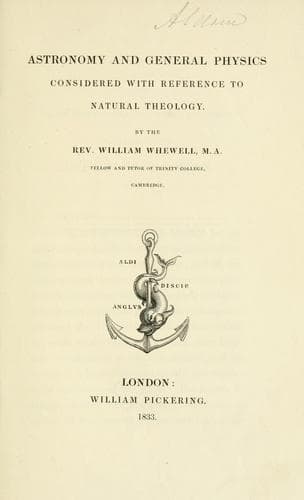
Astronomy and General Physics Considered with Reference to Natural TheologyWhewell, William
Religion
Astronomy and General Physics Considered with Reference to Natural Theology
Whewell, William
Astronomy; Cosmic physics; Natural theology
1. The sciences which have at present acquired any considerable
degree of completeness, are those in which an extensive and
varied collection of phenomena, and their proximate causes, have
been reduced to a few simple general laws. Such are Astronomy
and Mechanics, and perhaps, so far as its physical conditions
are concerned, Optics. Other portions of human knowledge can
be considered as perfect sciences, in any strict sense of the
term, only when they have assumed this form; when the various
appearances which they involve are reduced to a few principles,
such as the laws of motion and the mechanical properties of the
luminiferous ether. If we could trace the endless varieties of
the forms of crystals, and the complicated results of chemical
composition, to some one comprehensive law necessarily pointing out
the crystalline form of any given chemical compound, Mineralogy
would become an exact science. As yet, however, we can scarcely
boast of the existence of any other such sciences than those which
we at first mentioned: and so far therefore as we attempt to give
definiteness to our conception of the Deity, by considering him
as the intelligent depositary and executor of laws of nature, we
can subordinate to such a mode of conception no portion of the
creation, save the mechanical movements of the universe, and the
propagation and properties of light.
2. And if we attempt to argue concerning the nature of the laws
and relations which govern those provinces of creation whither our
science has not yet reached, by applying some analogy borrowed from
cases where it has been successful, we have no chance of attaining
any except the most erroneous and worthless guesses. The history of
human speculations, as well as the nature of the objects of them,
shows how certainly this must happen. The great generalizations
which have been established in one department of our knowledge,
have been applied in vain to the purpose of throwing light on
the other portions which still continue in obscurity. When the
Newtonian philosophy had explained so many mechanical facts, by
the two great steps,--of resolving the action of a whole mass
into the actions of its minutest particles, and considering these
particles as centres of force,--attempts were naturally soon made
to apply the same mode of explanation to facts of other different
kinds. It was conceived that the whole of natural philosophy must
consist in investigating the laws of force by which particles of
different substances attracted and repelled, and thus produced
motions, or vibrations _to_ and _from_ the particles. Yet what were
the next great discoveries in physics? The action of a galvanic
wire upon a magnet; which is not to attract or repel it, but to
turn it to the _right_ and _left_; to produce motion, not to or
from, but _transverse_ to the line drawn to the acting particles;
and again, the undulatory theory of light, in which it appeared
Public-domain text, read in full here on John Shaqi.
Reviews
Reviews
No reviews yet
Be the first to share your thoughts on this work.
Elsewhere in the archive
Join the Discussion
Join the discussion
Sign in to leave a comment or review.
Sign InorCreate an account