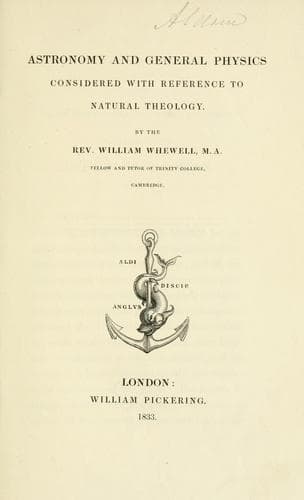
Astronomy and General Physics Considered with Reference to Natural TheologyWhewell, William
Religion
Astronomy and General Physics Considered with Reference to Natural Theology
Whewell, William
Astronomy; Cosmic physics; Natural theology
_On the Impression produced by considering the Nature and
Prospects of Science; or, on the Impossibility of the Progress of
our Knowledge ever enabling us to comprehend the Nature of the
Deity._
If we were to stop at the view presented in the last chapter,
it might be supposed that--by considering God as eternal and
omnipresent, conscious of all the relations, and of all the objects
of the universe, instituting laws founded on the contemplation
of these relations, and carrying these laws into effect by his
immediate energy,--we had attained to a conception, in some degree
definite, of the Deity, such as natural philosophy leads us to
conceive him. But by resting in this mode of conception, we should
overlook, or at least should disconnect from our philosophical
doctrines, all that most interests and affects us in the character
of the Creator and Preserver of the world;--namely, that he is the
lawgiver and judge of our actions; the proper object of our prayer
and adoration; the source from which we may hope for moral strength
here, and for the reward of our obedience and the elevation of our
nature in another state of existence.
We are very far from believing that our philosophy alone can give
us such assurance of these important truths as is requisite for
our guidance and support; but we think that even our physical
philosophy will point out to us the necessity of proceeding far
beyond that conception of God, which represents him merely as the
mind in which reside all the contrivance, law, and energy of the
material world. We believe that the view of the universe which
modern science has already opened to us, compared with the prospect
of what she has still to do in pursuing the path on which she has
just entered, will show us how immeasurably inadequate such a mode
of conception would be: and that if we take into our account, as
we must in reason do, all that of which we have knowledge and
consciousness, and of which we have as yet no systematic science,
we shall be led to a conviction that the Creator and Preserver
of the material world must also contain in him such properties
and attributes as imply his moral character, and as fall in most
consistently with all that we learn in any other way of his
providence and holiness, his justice and mercy.
Public-domain text, read in full here on John Shaqi.
Reviews
Reviews
No reviews yet
Be the first to share your thoughts on this work.
Elsewhere in the archive
Join the Discussion
Join the discussion
Sign in to leave a comment or review.
Sign InorCreate an account